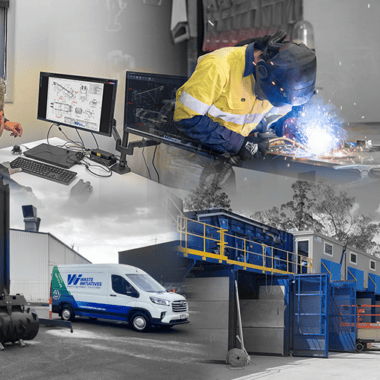
Across Australia, waste volumes continue to rise alongside population growth, urban density and changing consumption patterns. While each state faces its own regulatory environment and infrastructure constraints, a consistent theme emerges from recent state-based waste and recycling reports: the ability to effectively sort material at scale is becoming one of the biggest determinants of recycling performance.
From metropolitan councils managing millions of households, to regional facilities under pressure from transport costs and landfill levies, the data shows that improving front-end separation and manual quality control is no longer optional. It is foundational.
We examine key waste and recycling trends at a state level, drawing on the latest publicly available reports from New South Wales, Victoria, Queensland, Western Australia and South Australia, and explore why sorting systems and picking stations are increasingly critical infrastructure for processors and councils managing waste as the population of Australia continues to grow.
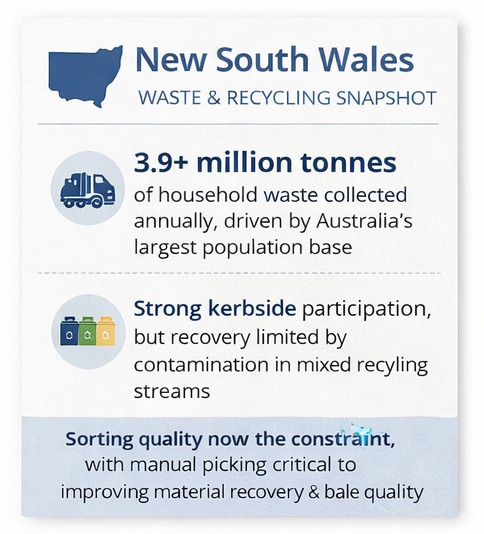 New South Wales: Scale, Density and the Sorting Bottleneck
New South Wales manages the largest municipal waste task in Australia. According to the NSW Local Government Waste and Resource Recovery Data Report 2022–23, councils collected approximately 3.9 million tonnes of domestic waste during the reporting year.
Of this total:
- Around 48% was recovered through recycling and organics processing
- More than 2.2 million tonnes still went to landfill
- Dry recyclables accounted for nearly 800,000 tonnes, largely processed through material recovery facilities (MRFs)
While recycling performance has improved incrementally over time, the data highlights a persistent issue: contamination and material loss within mixed streams. Even where kerbside participation is high, recovery outcomes are constrained by the effectiveness of downstream sorting.
As councils roll out FOGO services and expand container deposit schemes, MRFs are being asked to process more complex, more contaminated input streams. This is placing pressure on legacy infrastructure that may not be evolving as quickly as changes in waste profiles.
For councils and processors, sorting solutions remain a critical component to waste management because they can assist in:
- Removing contamination before mechanical separation
- Improving bale quality and marketability
- Recovering higher-value materials that automated systems may miss, however it is important to note that the emergence of AI into automated processes will improve automated sorting as the technology develops further
Without investment in flexible, scalable sorting infrastructure, further gains in diversion rates will remain a challenge.
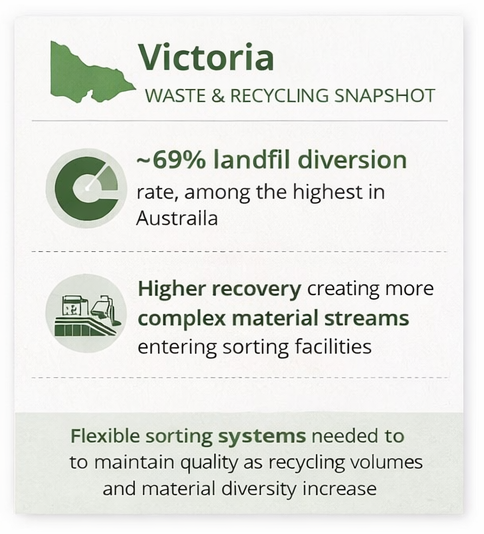 Victoria: Strong Diversion, Rising Complexity
Victoria currently reports one of the strongest landfill diversion rates in the country. The Recycling Victoria Annual Report 2023–24 shows an overall landfill diversion rate of approximately 69%, exceeding the national average.
This performance reflects significant reform, including:
- State-wide kerbside consistency
- Introduction of the Container Deposit Scheme
- Increased infrastructure planning and data transparency
However, higher diversion does not equate to lower operational complexity. In fact, Victoria’s success has driven greater material variety entering sorting facilities, particularly in metropolitan areas.
Key challenges identified in the report include:
- Managing risk and service continuity in recycling infrastructure
- Ensuring consistent quality of recovered materials
- Supporting local government procurement of fit-for-purpose systems
As recycling targets increase, sorting solutions become a stabilising factor. Mobile picking stations allow operators to adapt quickly to changes in inbound material without major civil works or long lead times, making them particularly valuable for councils servicing large and growing populations.
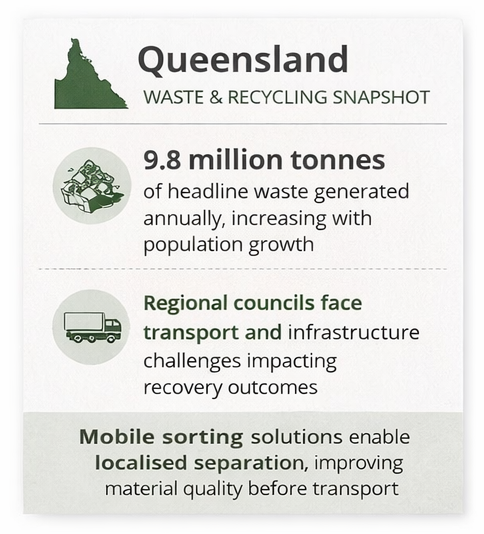 Queensland: Growth Pressures and Regional Reality
Queensland’s waste profile is shaped by rapid population growth, decentralised regional centres and long transport distances. The Recycling and Waste in Queensland 2024 report highlights ongoing challenges in improving recovery rates while managing cost pressures across diverse council regions.
Key themes include:
- Increasing waste generation driven by population growth
- Variability in access to advanced sorting infrastructure
- Reliance on transfer and aggregation for regional councils
For many Queensland councils, the barrier to improved recovery is not community participation, but lack of flexible processing infrastructure close to source.
Mobile picking stations offer a practical pathway forward in more remote areas, enabling councils and processors to:
- Establish interim sorting capacity without permanent buildings
- Improve material quality before transport
- Support regional hubs servicing multiple local government areas
As Queensland continues to invest in waste reform, sorting systems that can be deployed quickly and relocated as needs change will play a critical role.
 Western Australia: Distance, Landfill Costs and Recovery Opportunities
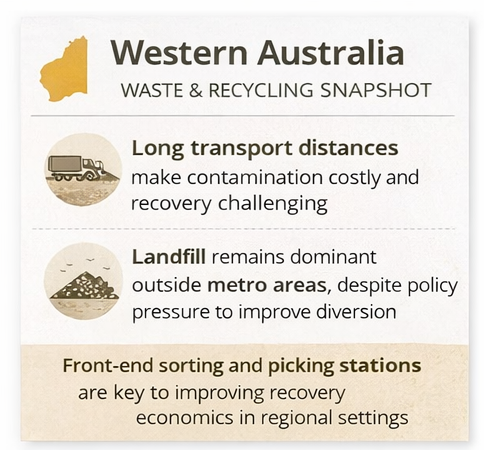
Western Australia faces a unique waste challenge shaped by geographic scale and distance. The WA Waste Data Report 2022–23 shows continued reliance on landfill, particularly outside metropolitan Perth, alongside increasing policy pressure to improve recovery outcomes.
In regional WA, transport costs can quickly outweigh the value of recovered materials. As a result, pre-sorting and contamination reduction become essential to making recycling economically viable.
Key opportunities identified include:
- Improved source separation
- Better front-end sorting of mixed loads
- Increased recovery of metals, timber and plastics from C&D and municipal streams
Mobile picking stations may be an effective option for achieving these outcomes, particularly where full-scale automated MRFs are not feasible.
 South Australia: High Performance, High Expectations
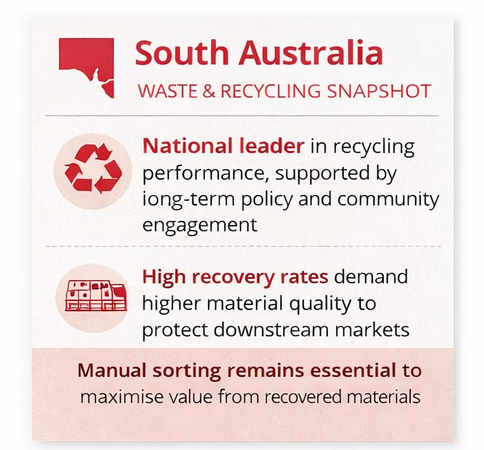
South Australia continues to be recognised as a national leader in waste recovery and recycling performance, underpinned by long-standing policy settings, strong landfill levy signals and high community participation. According to the state’s Circular Economy and Resource Recovery (CERR) Summary 2022–23, South Australia consistently achieves some of the highest diversion rates in Australia, particularly across municipal and commercial waste streams.
This performance reflects decades of investment in kerbside systems, container deposit schemes and local processing capacity. However, the data also highlights an important reality: as recovery rates increase, so do expectations around material quality.
With higher volumes of recyclables being captured, processors are now dealing with:
- Greater variability in inbound material quality
- Higher contamination risks within mixed streams
- Increased scrutiny from domestic and export markets demanding cleaner feedstock
In this environment, recovery is no longer just about diverting material from landfill, it’s about recovering the right material, to the right standard.
As South Australia continues to push toward more circular outcomes, sorting quality becomes the next major lever for improvement. Mobile picking and sorting systems offer a practical way to enhance existing infrastructure, particularly where operators need to increase quality without major capital rebuilds or long lead times.
Why Sorting Systems and Picking Stations Matter More Than Ever
Across all states, the data points to a common conclusion: improving sorting solutions will be a key driver in improving efficiency in waste management.
While policy reform, kerbside standardisation and community education have driven strong participation, the next gains in recycling performance will come from how well material is sorted after collection.
Sorting systems and picking stations enable:
- Improved recovery rates from existing waste streams
- Reduced contamination penalties
- Greater flexibility as waste profiles evolve
- Better resilience for councils managing population growth
Importantly, modern picking stations are no longer limited to static, large-scale facilities. Mobile and modular systems allow councils and processors to respond faster, pilot new approaches and scale infrastructure in line with demand.
Setting the Foundation for Smarter Waste Systems
As Australia’s waste challenge continues to grow, the role of sorting infrastructure will only increase. The state-based data makes it clear that councils and processors need solutions that are:
- Proven
- Flexible
- Scalable
- Aligned with real-world operational constraints
This is why Waste Initiatives is expanding its focus beyond individual equipment items to deliver complete sorting solutions, including mobile picking stations and integrated systems designed for Australian conditions.
Mobile picking stations can be deployed across municipal, C&D, C&I, organic and commercial waste streams, and they can form a practical bridge between today’s infrastructure and the more advanced sorting systems.
Contact Waste Initiatives to discuss how our picking station and sorting system solutions can help you improve recovery, reduce contamination and future-proof your waste operations.
Latest news
What Did Your Waste Operation Tell You This Year?
79 Million Tonnes of Waste: What Australia’s Latest Data Reveals