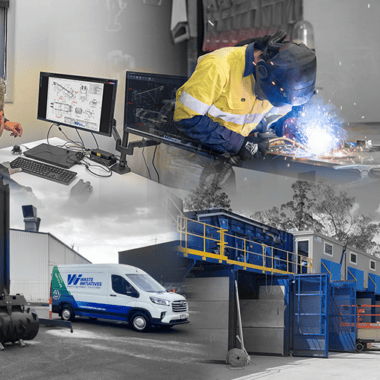
Across Australia, the waste and recycling industry is changing rapidly.
Councils are under pressure to improve diversion rates. Manufacturers are searching for more efficient ways to handle bulky waste streams. New recycling businesses are emerging to process difficult materials that were previously sent to landfill. At the same time, landfill costs, transport pressures, contamination challenges and sustainability expectations continue to rise.
But one thing is becoming increasingly clear across all sectors of the industry:
Waste challenges are rarely solved by a single machine.
Successful waste and recycling operations are increasingly built around system knowledge. Understanding the material, how it behaves, how it moves through a process and what happens downstream is now just as important as the equipment itself.
This is where experience matters.
At Waste Initiatives, we work with councils, recyclers, manufacturers and emerging operators to help turn waste challenges into practical processing solutions. Sometimes that may involve a single piece of equipment. In many cases, it involves integrating multiple technologies into a system designed around the waste stream itself.
Importantly, successful projects also rely on more than equipment supply alone. Local engineering, project management, installation, commissioning, operator training and ongoing service support all play a major role in ensuring systems continue to perform effectively long after commissioning.
The Shift from Waste Disposal to Material Recovery
Historically, many waste streams were simply collected and disposed of.
Today, the focus has shifted toward recovery, reuse and resource efficiency.
That means businesses and councils are increasingly asking:
- Can this material be recovered?
- Can transport costs be reduced?
- Can contamination be removed?
- Is there an end market for the processed output?
- Can multiple waste streams be integrated into a viable recycling operation?
Answering these questions requires more than equipment selection alone. It requires an understanding of throughput, contamination, separation, material handling and downstream recovery.
It also requires practical experience in how systems operate in real-world Australian conditions, from regional council facilities through to high-volume industrial processing sites.
FOGO Processing Requires More Than Depackaging Alone
Food Organics and Garden Organics (FOGO) continues to be one of the fastest-growing areas in the Australian waste industry.
As councils and operators expand organics collection programs, the focus is now turning toward contamination management and processing efficiency.
Packaged food waste is one of the biggest challenges in this space. Removing packaging while maintaining a clean organic output is critical for downstream composting and anaerobic digestion operations.
This is where systems like the Mavitec depackaging range play an important role.
However, successful organics processing rarely begins and ends with depackaging alone.
Operators may also require:
- Pre-sorting systems
- Picking stations
- Conveyors
- Screening equipment
- Contaminant removal systems
- Material handling integration
The cleaner the feedstock entering the process, the better the recovery outcome downstream.
This is where integrated system design becomes critical. Equipment must work together efficiently to maintain throughput while minimising contamination and operational downtime.
Tyre Recycling Requires Integrated Size Reduction
Tyres remain one of the most difficult waste streams to process efficiently.
They are bulky, difficult to transport and require multiple stages of processing before they can become a usable product such as crumb rubber or tyre derived fuel (TDF).
This is why tyre recycling systems are often built around staged size reduction and material separation.
Waste Initiatives works with technologies such as Barclay tyre shredders to support tyre processing operations across Australia.
Depending on the application, a tyre recycling system may involve:
- Debeading
- Sidewall removal
- Primary shredding
- Secondary shredding
- Screening or classifying
- Steel separation
- Conveying systems
Understanding how each stage interacts with the next is critical to achieving throughput, product quality and operational efficiency.
Project planning and system integration are particularly important in tyre recycling operations, where material flow and processing balance can significantly affect output quality and operating costs.
Manufacturing Waste Often Requires Practical Compaction Solutions
Not every waste challenge requires a large processing facility.
Many manufacturing operations simply need a practical way to manage bulky waste streams more efficiently.
This is particularly common with:
- Timber crates
- Cardboard cores
- Bulky packaging waste
- Production offcuts
These materials are often difficult to transport efficiently due to their size and shape.
In these situations, technologies such as Bergmann roll packers can significantly improve handling efficiency by compacting waste directly into open skip bins.
Rather than redesigning an entire waste system, manufacturers can often achieve major operational improvements through:
- Reduced transport movements
- Improved bin utilisation
- Cleaner waste handling areas
- Reduced labour handling
The key is understanding the waste stream and selecting the right solution for the operational challenge.
Cardboard Recovery Is Not One-Size-Fits-All
Cardboard remains one of the most common recyclable waste streams across councils, retail, warehousing and manufacturing.
However, the right baling solution depends entirely on volume and operational flow.
For lower to medium volumes, vertical balers remain an effective and practical solution. They reduce storage requirements, create dense recyclable bales and improve handling efficiency.
For larger facilities generating continuous cardboard waste, horizontal balers may be more appropriate due to:
- Higher throughput
- Continuous feed capability
- Automated operation
- Reduced labour handling
Again, this highlights why system knowledge matters.
Choosing the wrong equipment for the waste profile can create bottlenecks, labour inefficiencies and unnecessary operational costs.
MRFs Depend on Material Flow and Integration
Material Recovery Facilities (MRFs) continue to evolve as councils and recyclers seek greater recovery rates and improved processing flexibility.
Modern MRFs are no longer just about sorting materials. They are increasingly focused on:
- Material flow
- Contamination removal
- Operational flexibility
- Throughput efficiency
- Labour optimisation
This is why mobile and modular solutions are becoming increasingly important.
Mobile picking stations and tracked trommels provide operators with the ability to:
- Scale operations progressively
- Relocate equipment between sites
- Process varying waste streams
- Reduce upfront infrastructure requirements
These systems are particularly valuable for:
- Regional councils
- Temporary operations
- Staged infrastructure rollouts
- Emerging recycling businesses
The flexibility of mobile systems can help operators adapt as waste streams and market conditions change over time.
Importantly, these systems also require practical layout planning, conveyor integration, electrical considerations and site-specific engineering to ensure they operate efficiently and safely.
Mattress Recycling Highlights the Importance of Separation
Mattress recycling is another example of a waste stream that requires system thinking.
A mattress contains multiple recoverable materials including:
- Steel
- Foam
- Timber
- Textiles
However, these materials must first be separated efficiently.
This is where shredding and size reduction systems become essential.
Shredders allow operators to:
- Reduce handling labour
- Improve material separation
- Increase throughput
- Prepare materials for downstream recovery
Without effective size reduction and separation, mattress recycling can quickly become labour intensive and inefficient.
Full-Service Capability Matters More Than Ever
As waste systems become more integrated, support capability becomes increasingly important.
Today, operators are not simply looking for equipment suppliers. They are looking for partners capable of supporting projects from concept through to operation.
That includes:
- System design
- Local engineering support
- Project management
- Equipment integration
- Installation and commissioning
- Operator training
- Preventative maintenance
- Ongoing service and spare parts support
Having access to local support and technical knowledge can make a significant difference to system uptime, operational efficiency and long-term project success.
The Industry Is Moving Toward Integrated Solutions
One of the biggest shifts occurring across the waste industry is the move away from standalone equipment purchases toward integrated waste systems.
Operators are increasingly considering:
- How waste enters the process
- How material flows through the system
- How contamination is removed
- How throughput is maintained
- How processed output reaches an end market
This is particularly important for startups and emerging recycling businesses.
Many new operators enter the market focused on a single waste challenge, only to discover that successful processing often requires multiple integrated stages.
That is why experience and system knowledge are becoming more valuable than ever.
Future-Proofing Waste Operations
The waste and recycling industry will continue to evolve as landfill pressures, sustainability targets and resource recovery expectations increase.
For councils, manufacturers, recyclers and new operators alike, the challenge is no longer simply managing waste.
It is designing practical systems capable of adapting to changing waste streams, processing requirements and market conditions.
The businesses that succeed will be those that understand not just the equipment, but the complete process around the material itself.
Waste Initiatives works with councils, recyclers, manufacturers and emerging operators across Australia to help develop practical waste and recycling solutions built around real operational challenges.
From standalone equipment through to complete integrated systems, out focus remains the same: delivering practical, fit-for-purpose solutions backed by local engineering, project management and nationwide service support.
Talk to Waste Initiatives about future-proofing your operation or developing a solution for your waste stream.
Latest news
What Did Your Waste Operation Tell You This Year?
79 Million Tonnes of Waste: What Australia’s Latest Data Reveals