Australia’s growing reliance on electrical and electronic equipment is creating an equally important challenge at the other end of the product lifecycle: how to recover useful materials once that equipment reaches end of life.
Australian Government research estimates that Australia generated around 511,000 tonnes of e-waste in 2019, with this forecast to approach 657,000 tonnes by 2030. Yet only around one-third of the material value contained in Australian e-waste is estimated to be recovered.
For recyclers, the opportunity is not simply collecting more electronic waste or diverting it from landfill. The more complex challenge is turning products containing interconnected steel, aluminium, copper, plastics, wiring, motors, printed circuit boards (PCBs) and other materials into sufficiently clean fractions for sale or further processing.
That requires more than shredding.
An effective mechanical recycling process can be understood through three principles:
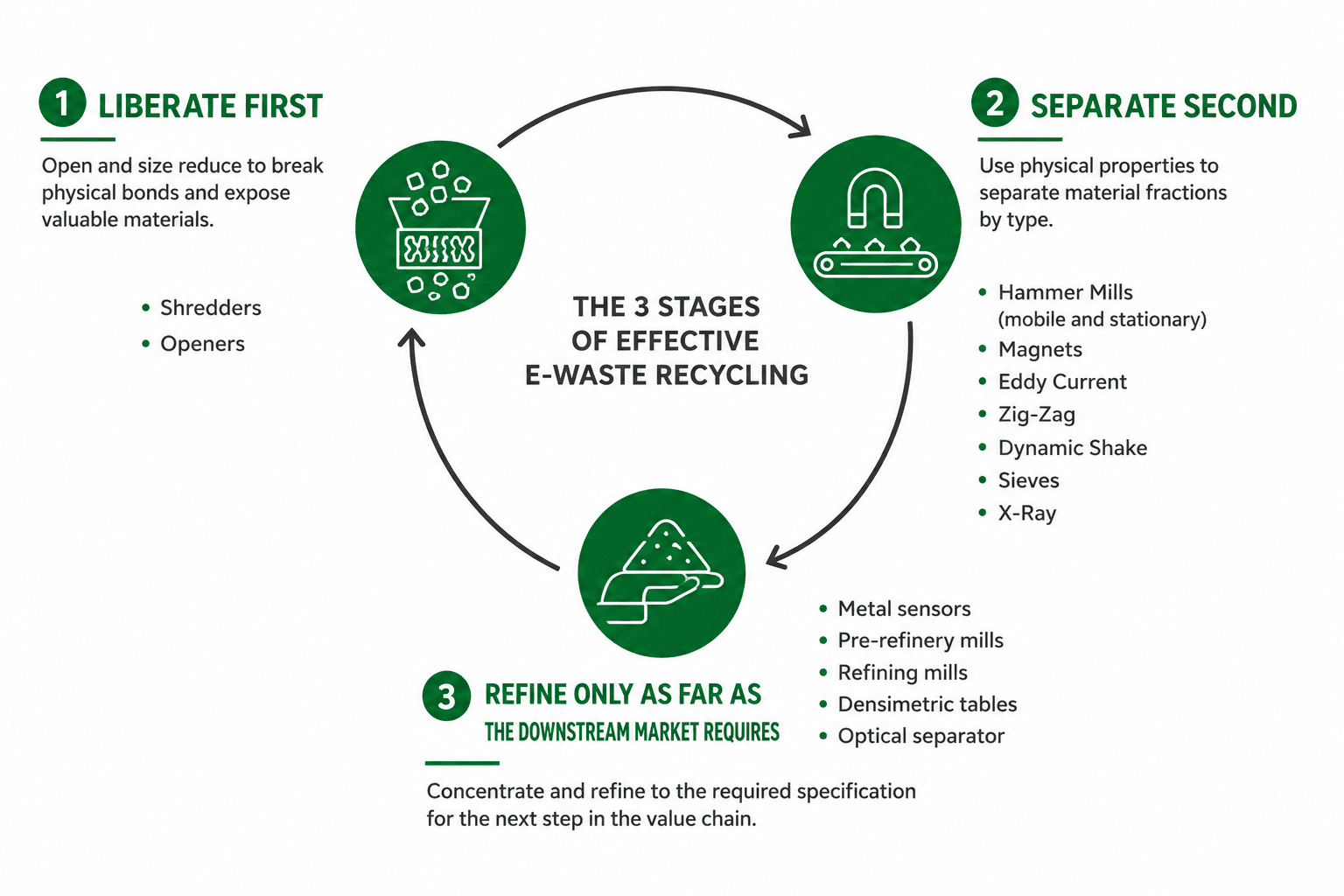
Liberate first. Separate second. Refine only as far as the downstream market requires.
Understanding these principles helps explain why modern WEEE, PCB and battery recycling systems combine multiple stages of size reduction, classification and separation rather than relying on a single machine.
Why shredding alone is not enough
Waste electrical and electronic equipment, commonly referred to as WEEE, is fundamentally different from a relatively homogeneous waste stream.
An electrical appliance may contain a steel housing, electric motors, wiring, printed circuit boards, aluminium, plastics and numerous smaller components. Within these components, materials are often physically connected.
Copper may be wound around steel inside an electric motor. Copper conductors are surrounded by plastic insulation in electrical cable. Conductive metals are bonded to fibreglass and resin within PCBs. Metal inserts may also be moulded directly into plastic components.
Before these materials can be effectively separated, those physical connections need to be broken.
This is why a mechanical WEEE recycling process may incorporate several stages and each stage has a different purpose.
The objective is not simply to make the waste progressively smaller. It is to create the physical conditions required for the next separation stage to operate effectively.
Primary reduction opens the material
The first mechanical size-reduction stage typically opens products, reduces bulky material and exposes internal components for subsequent processing.
Depending on the feedstock and required output, industrial shredders can perform this role across a range of WEEE applications.
The important consideration is what needs to happen after this first stage.
For recyclers, this highlights an important distinction when selecting equipment.
The question should not simply be, “How powerful is the shredder?”
A better question is, “What condition does the material need to be in when it leaves the primary reduction stage?”
If components need to be manually or automatically removed, excessive reduction may make that task more difficult. If the material will move directly into secondary refining, the required characteristics may be different.
Primary reduction therefore needs to be selected as part of the complete recycling process, rather than as an isolated machine.
Liberation is different from size reduction
Once WEEE has been opened and major components removed where required, further mechanical processing may be needed to separate materials that remain physically connected.
This is where hammer mills and other refining technologies can become important.
A useful way to think about the difference is:
A shredder makes material smaller using a cutting or shearing process. A hammer mill smashes material apart making individual materials easier to separate.
Hammer milling can help free copper windings from motor components, separate metal inserts from plastics, break electrical components apart and prepare composite materials for subsequent physical separation.
However, reducing material to the smallest possible size is not necessarily the objective.
Excessive size reduction can create unnecessary fines, increase dust and potentially increase cross-contamination between material fractions. Very fine material can also present additional challenges for subsequent separation equipment.
The required particle size therefore needs to be considered alongside the characteristics of the waste and the requirements of the next separation stage.
This is the point where size reduction becomes material liberation.
Separating the liberated materials
Once materials have been sufficiently liberated, different separation technologies can exploit their physical characteristics.
Magnetic separation is used to remove ferrous metals such as iron and steel.
Eddy-current separation can separate conductive non-ferrous metals from non-conductive materials. Once WEEE has been sufficiently reduced and classified, this technology recovers fractions containing materials such as aluminium and copper.
Density separation provides a further refining stage.
Importantly, none of these technologies operates independently of the processes before it.
Liberation, particle-size distribution, density differences, moisture, contamination and feed consistency can all influence separation performance.
A highly capable separator cannot compensate for material that has not been adequately prepared for separation.
That is why WEEE recycling systems need to be engineered as a complete process. The performance of one stage influences what is achievable at the next.
PCBs require a more refined process
Printed circuit boards represent a particularly valuable but technically complex fraction within the wider electronic waste stream.
Depending on their type and origin, PCBs can contain copper, tin, aluminium, ferrous material and precious-metal-bearing components, alongside fibreglass, resin, plastics and other non-metallic materials.
Their potential value can create a misleading impression of what mechanical PCB recycling actually achieves.
A mechanical recycling line does not simply turn circuit boards into separate piles of copper, gold, silver and palladium.
Instead, PCB systems mechanically reduce and separate PCB material to concentrate metallic fractions away from the non-metallic board substrate.
The resulting metal-rich or precious-metal-bearing fraction can then be supplied for specialist metallurgical or chemical refining.
This distinction is important when developing the commercial model for PCB recycling.
Processors need to determine whether it makes more sense to sell intact boards, mechanically concentrate their metallic content or undertake additional refining.
PCB grade, feed volume, metal content, operating costs, achievable purity and the requirements of downstream refiners can all influence that decision.
The right level of processing is ultimately determined by what the next stage of the recovery chain requires.
Recovery rate does not tell the whole story
A plant could potentially achieve a high overall recovery percentage while producing contaminated or low-value fractions.
Recovery rate alone therefore provides an incomplete picture of recycling performance.
Other considerations can include material purity, yield per tonne, losses into residual fractions, labour requirements, energy consumption, maintenance, consumables, transport, downstream processing charges and disposal costs.
Downstream markets should consequently be considered during the initial plant design rather than after equipment has been installed.
Processors need to understand what potential buyers require, including acceptable contamination levels, particle-size ranges, minimum shipment quantities and whether the material will be purchased as a commodity or as feedstock for further refining.
Clean ferrous metals, aluminium and sufficiently pure copper fractions may have established downstream markets. PCB metal concentrates are more appropriately considered intermediate materials requiring specialist further processing.
For this reason, a more meaningful objective than simply achieving the highest recovery percentage is producing separated material streams suitable for sale, further refining or downstream recovery.
Designing for Australian operating conditions
Processing performance is only one part of developing an electronic waste recycling facility in Australia.
Depollution requirements, dust extraction, fire protection, air emissions, noise, material storage, maintenance access and operator safety can all influence plant configuration.
Regulatory requirements also differ according to the waste stream and jurisdiction.
Australia’s National Television and Computer Recycling Scheme covers televisions, computers, printers, computer parts and peripherals, but does not cover the entire WEEE stream.
Victoria has prohibited e-waste from landfill since July 2019, while EPA Victoria identifies AS 5377:2022 as the Australian standard covering the collection, transport and treatment of electrical and electronic equipment for reuse or recycling.
Because regulatory requirements are constantly developing on both a federal and state level, processors should confirm the current requirements applying to their jurisdiction and specific battery categories during project development.
Start with the feedstock, not the machine
There is no single WEEE, PCB or battery recycling line suitable for every application.
A recycler processing mixed small electrical appliances has very different requirements from a specialist PCB processor. A high-volume WEEE facility may require a different approach again, while lithium-ion batteries introduce an additional front-end risk profile that needs to be managed before mechanical processing begins.
The starting point should therefore be the material itself.
- What is the feedstock?
- What volumes need to be processed?
- What are the maximum input dimensions?
- Does the material require depollution or pre-dismantling?
- What output fractions need to be produced?
- What level of purity does the downstream buyer require?
- Where will those recovered fractions go?
- And what infrastructure is available at the processing site?
Only once these questions are understood can the appropriate combination of shredding, liberation, classification and separation equipment be determined.
Waste Initiatives works with recycling businesses to assess these requirements and develop complete processing systems, drawing on technologies from specialist international manufacturers including Stokkermill and Panizzolo alongside locally supported equipment.
This includes equipment selection, process design and integration, through to Australian project delivery, installation, commissioning, training and ongoing service support.
For complex electronic waste streams, the most important question is not simply, “What machine can process this waste?”
It is, “What materials enter the plant, what fractions need to leave it, and what processing stages are required between those two points?”
Getting that process right is what turns size reduction into effective material recovery.
Planning a WEEE or PCB recycling project? Speak with the Waste Initiatives team about your feedstock, required outputs and processing objectives to determine the most appropriate approach.
Frequently Asked Questions
What is e-waste recycling?
E-waste recycling is the process of recovering useful materials from end-of-life electrical and electronic equipment. Depending on the feedstock, this can involve depollution, dismantling, size reduction, material liberation, screening and separation to recover fractions such as ferrous metals, non-ferrous metals and plastics.
Is shredding enough to recycle e-waste?
No. Shredding reduces the size of electronic waste and can expose internal components, but it does not necessarily separate the individual materials. Effective recovery typically requires further liberation and separation processes to turn mixed shredded material into cleaner, more useful fractions.
What is the difference between shredding and hammer milling?
Shredding is generally used for primary size reduction, opening products and reducing bulky material into smaller pieces. Hammer milling provides further size reduction and liberation by using impact forces to break apart composite materials and free materials that remain physically connected. The appropriate process depends on the feedstock and the required downstream separation.
What does material liberation mean in e-waste recycling?
Material liberation means breaking the physical connections between different materials so they can be separated. For example, copper may need to be liberated from steel components, plastic insulation or other materials before separation equipment can effectively recover it.
How are different materials separated from e-waste?
Once materials have been sufficiently liberated and appropriately sized, different technologies can be used according to their physical properties. Magnetic separators can recover ferrous metals, eddy-current separators can target conductive non-ferrous materials, while density separation can further separate materials according to differences in relative density.
How are printed circuit boards recycled?
PCB recycling can involve controlled size reduction and separation to concentrate metallic material away from fibreglass, resin and other non-metallic components. The resulting metal-rich fraction may contain copper and precious-metal-bearing material, but typically requires specialist downstream refining to recover individual metals.
Does PCB recycling recover gold and other precious metals?
Mechanical PCB processing can concentrate precious-metal-bearing material, but it should not automatically be described as producing recovered gold, silver or palladium. The concentrated metallic fraction generally requires further metallurgical or chemical refining to recover individual precious metals.
What determines the right e-waste recycling process?
The appropriate process depends on the feedstock, required throughput, input dimensions, level of pre-dismantling, target material fractions, required purity and downstream markets. Rather than selecting individual machines in isolation, these factors should be considered when designing the complete processing system.
Why do downstream markets matter when designing a recycling system?
The required output specification can determine how far material needs to be processed. A downstream buyer may have requirements for purity, contamination, particle size and shipment volume. Processing material beyond the specification required by the next buyer can add unnecessary complexity and cost, which is why the principle is to liberate first, separate second, and refine only as far as the downstream market requires.
Latest news
What Did Your Waste Operation Tell You This Year?
79 Million Tonnes of Waste: What Australia’s Latest Data Reveals