Tonnes per hour is one of the most important specifications when selecting waste and recycling equipment. If a facility needs to process a defined volume during an operating shift, the equipment must have sufficient capacity to do it.
But selecting a machine with sufficient throughput is only the first part of designing a processing system.
Once that machine is connected to feeders, conveyors, screens, separators or further size-reduction equipment, its individual throughput becomes one component of a much larger performance equation.
The focus needs to shift from machine throughput to processing line performance.
For an integrated system, the more useful question is not simply how many tonnes per hour the primary machine can process. It is:
Can the complete line reliably process the required volume and produce the required output?
Answering that question requires understanding the material, the purpose of each processing stage and how the equipment works together.
Machine throughput is the starting point
Published throughput figures provide valuable information when evaluating equipment.
They help determine whether a machine is within the appropriate capacity class for an application and allow buyers to compare different equipment options. Throughput can also help identify immediately when a machine is unlikely to meet the required production volume.
The important distinction is between machine capacity and system capacity.
Equipment throughput is linked to the material and operating conditions under which the machine is used. Once equipment becomes part of a processing line, upstream and downstream stages introduce additional variables.
A high-capacity primary machine can only contribute its full potential if material can be supplied to it appropriately and subsequent equipment can handle what it produces.
This means a machine’s tonnes-per-hour figure should not automatically be treated as the tonnes-per-hour capacity of the completed installation.
The material determines the processing task
Before considering how machines interact, it is important to understand what they are being asked to process.
A tonne is a measure of mass. It does not describe the physical characteristics of the material making up that tonne.
Bulk density, composition, moisture, contamination, feed size and consistency can all influence the processing task. Oversized or difficult material within an otherwise consistent feed can introduce another variable.
A tonne of relatively dense and consistent material presents a different handling challenge from a tonne of lightweight, bulky or highly variable material.
Those differences can affect feeding, size reduction, conveying and screening throughout the line.
Required output also matters.
A shredder undertaking coarse primary size reduction is performing a different task from equipment required to create a smaller and more consistent fraction. Similarly, a trommel needs to achieve its required screening or separation objective, rather than simply pass the greatest possible tonnage through the drum.
For this reason, understanding the incoming material and required output is fundamental to determining what a throughput figure means in a particular application.
From individual machines to a balanced line
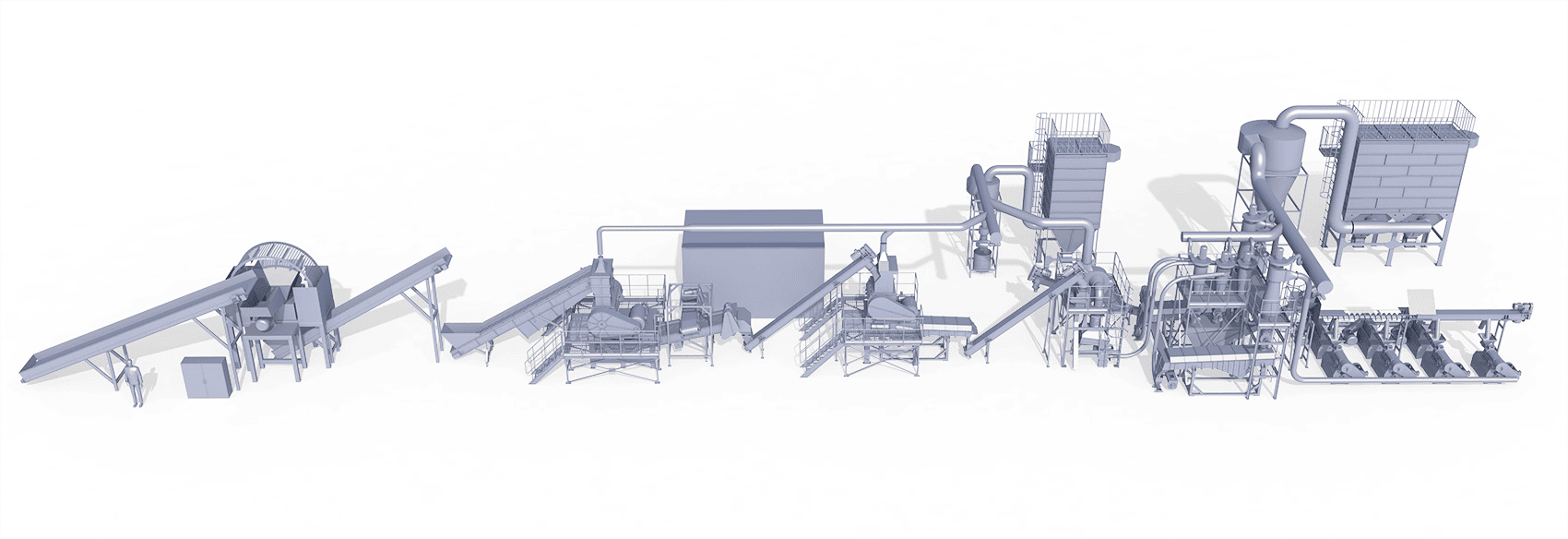
The shift from machine throughput to processing line performance becomes particularly important when multiple processing stages are connected.
A system could include:
Feed → Shredding → Conveying → Screening → Separation → Refining → Discharge
Each stage has a particular job to perform and its own practical capacity.
Consider a primary shredder capable of processing material faster than the downstream screening or separation equipment can accept it. Increasing the shredder’s capacity will not necessarily increase the sustained production rate of the complete line.
Instead, material may accumulate between processes or the upstream feed rate may need to be reduced.
The same issue can occur elsewhere. Conveying, screening, separation, refining or discharge can potentially constrain the overall process if that stage cannot keep pace with the required production rate.
This introduces an important principle in processing system design: line balancing.
The highest-throughput machine does not necessarily create the highest-performing processing line.
Line balancing does not mean selecting equipment with identical published tonnes-per-hour figures. Different stages perform different processes, and additional capacity can be useful at particular points.
For example, a machine with capacity above the average line rate may help accommodate inconsistent feeding or periods of higher incoming volume. Additional capacity may also provide operational flexibility or accommodate anticipated production growth.
The objective is therefore not to make every specification identical. It is to select and configure equipment so that the individual stages work effectively together at the required production rate.
Processing line performance includes the output
A processing line also needs to be assessed by what it produces.
Processing a high volume of material has limited value if the resulting output does not meet the requirements of the next process or intended downstream application.
Depending on the material and processing objective, this can require further size reduction, screening, removal of contamination or separation into different recovered fractions.
Every additional processing stage has a purpose, but it also becomes part of the overall capacity equation.
A further refining stage, for example, may be necessary to achieve the required output even if it means the line cannot operate at the maximum nominal capacity of the primary machine.
This is why tonnes per hour should be connected to the processing objective.
Instead of asking only:
“How many tonnes per hour can this machine process?”
the system-level question becomes:
“How many tonnes per hour can this line process to the output specification we require?”
The distinction is important because it changes what good performance looks like.
The objective is not necessarily to move the greatest possible mass through the equipment. It is to achieve the required production volume while completing the processing task the system was designed to perform.
Shredders: output size changes the throughput question
Shredders provide another clear example of why machine throughput needs to be considered within the processing objective.
Material type, feed characteristics, cutting configuration and required output size can influence what the shredder is being asked to achieve.
A coarse primary reduction and a smaller, more consistent output are different processing requirements. Comparing tonnes per hour without considering those differences can therefore provide an incomplete picture.
There is also the wider line to consider.
The feeding system needs to present material appropriately to the shredder. Conveyors need to move the shredded material away. If screening, separation or further refining follows, those processes need to accommodate the shredder’s output.
Selecting the shredder is therefore partly about machine capacity, but also about how its capacity and output fit the next processing stage.
Granulators: when further size reduction becomes the constraint
Where a granulator usually follows primary or secondary shredding. The relationship between the two machines is an important part of line performance.
The shredder may be capable of high throughput while producing a relatively coarse output, but the granulator performs the next stage of size reduction to achieve a smaller, more consistent fraction.
Its practical capacity needs to be considered against the size and consistency of material received from the shredder, the required final particle size and the needs of any downstream screening or separation equipment.
Increasing primary shredder throughput therefore does not necessarily increase complete-line capacity if the granulation stage cannot process material at the same sustained rate. In some applications, the more useful measure is not the maximum throughput of either machine individually, but the rate at which the shredder and granulator can operate together to produce material at the required size for the next stage of processing.
Design the line around the production requirement
Moving from machine selection to processing line design starts with defining the actual production requirement.
A useful framework is:
Material → Volume → Feed method → Required processing → Required output → Downstream equipment → Operating hours
Each variable answers a different part of the system-design question.
- Material establishes what the equipment needs to handle.
- Volume and operating hours establish the production rate required to process it.
- Feed method influences how consistently that material reaches the processing equipment.
- Required processing defines what needs to happen to the material.
- Required output establishes when the processing task is actually complete.
- Downstream equipment determines how the individual stages need to interact.
Considering these variables together can help identify potential constraints before equipment is installed.
It can also help determine where additional capacity is useful. A line designed around an average production rate may benefit from additional capacity at a particular stage to handle variable feed or peak loads.
The objective is not to maximise the specification of every individual machine. It is to configure the equipment around the performance required from the complete system.
Commissioning turns equipment into a processing line
Designing an integrated line does not finish when the equipment is selected.
The individual machines then need to operate together as a system.
This makes commissioning particularly important for processing lines. Once equipment is installed, the interaction between feeding, processing, conveying and downstream stages can be assessed under operating conditions.
Actual material can be introduced to the line, feed rates can be adjusted and equipment settings refined where required. Operators can also be trained to understand how changes at one stage can influence the rest of the process.
This is an important difference between supplying an individual machine and supporting an integrated processing solution.
Waste Initiatives supports complete waste and recycling systems from equipment selection and system integration through to installation, commissioning, operator training and ongoing servicing.
That whole-of-line approach means the focus remains on how the processing system operates together, rather than treating every component as an isolated piece of equipment.
Supporting line performance beyond installation
Processing line performance also needs to continue after commissioning.
Where several machines are integrated, an issue with one component can affect equipment elsewhere in the process. A disruption to feeding, conveying, screening or another stage can influence the production rate of the wider line even when the primary processing machine itself is operating correctly.
Ongoing support therefore benefits from a system-level understanding.
For customers, the investment is not simply in a shredder, trommel or depackaging machine capable of a stated tonnes-per-hour figure.
It is in a processing system expected to continue producing the required output over its operating life.
Waste Initiatives’ service and support capability extends across complete processing solutions, providing local support for integrated lines as well as individual equipment.
From throughput to performance
Throughput remains fundamental to waste and recycling equipment selection.
The shift occurs when an individual machine becomes part of a larger processing system.
At that point, the capacity of the primary equipment must be considered alongside material characteristics, feed consistency, processing requirements, downstream equipment and the required final output.
The question is no longer simply:
“Which machine has the highest throughput?”
It becomes:
“What combination of equipment will reliably process the required volume and produce the required output as a complete system?”
That is the difference between evaluating machine throughput and designing for processing line performance.
And it is why equipment selection, system integration, commissioning and ongoing support all need to be considered as parts of the same processing solution.
Talk to Waste Initiatives about designing a complete processing solution around your material, required throughput and output requirements.
Latest news
Why Effective E-Waste Recycling Requires More Than Shredding
What Happens to a Solar Panel at End of Life?