Selecting waste equipment is one of the most important infrastructure decisions an organisation can make. The right investment can reduce operating costs, improve workplace safety, increase recycling rates and simplify day-to-day operations for many years. The wrong investment, however, can result in higher labour costs, unnecessary transport expenses, underutilised equipment and operational bottlenecks that become increasingly difficult to overcome as a business grows.
Many purchasing decisions begin with a simple question: “Which machine do we need?“ While understandable, it is rarely the right place to start.
The better question is: “What problem are we trying to solve?“
Every operation generates waste differently. A manufacturing facility producing timber offcuts has vastly different requirements to a distribution centre processing cardboard packaging, while a council transfer station faces challenges unlike those of a food manufacturer handling wet organics. Even businesses within the same industry often require different equipment because their waste streams, volumes, available space and operational objectives vary considerably.
Successful waste equipment selection is therefore less about comparing machine specifications and more about understanding how waste is generated, handled and transported throughout your operation. This guide outlines the key considerations that should shape your decision, helping you select equipment that delivers long-term operational and financial value.
Why the Right Equipment Starts With Understanding the Problem
The most successful waste management projects don’t begin with equipment. They begin with understanding the operation.
While equipment specifications are important, they only represent one part of a much larger system. Waste handling influences labour efficiency, transport costs, workplace safety, material recovery, site layout and future operational flexibility. Selecting equipment without considering these broader factors often results in solutions that meet today’s immediate need but create tomorrow’s operational constraint.
Experienced engineers typically assess six key areas before recommending equipment:
- Your waste stream
- Waste volumes
- Material flow
- Operational objectives
- Site constraints
- Future growth
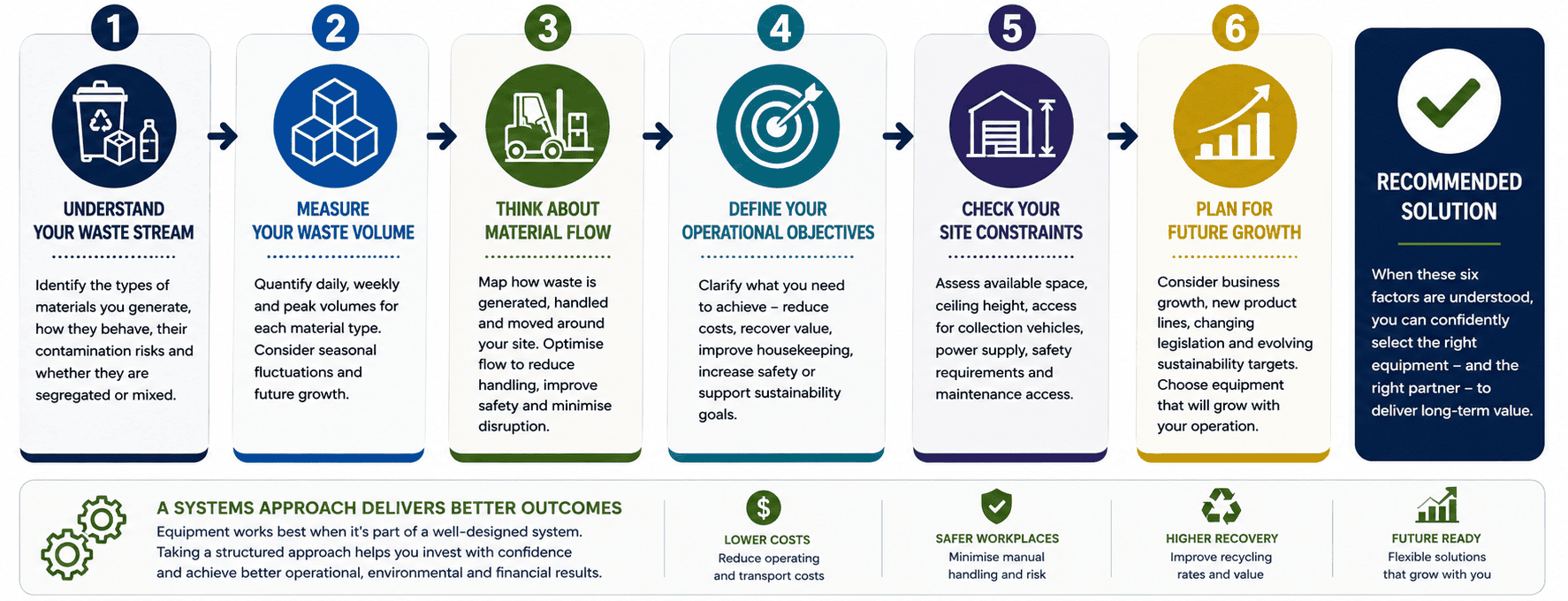
Step 1: Understand Your Waste Stream
Before considering equipment categories, it’s essential to understand exactly what waste your operation generates.
Start by identifying each individual waste stream produced across your facility. Typical commercial and industrial operations generate materials such as cardboard, mixed paper, plastic film, rigid plastics, timber, pallets, metals, general waste or organics. Each behaves differently during handling and compaction, meaning each may require a different processing approach.
For example, cardboard compresses efficiently into dense bales that are easy to transport and often attract commodity value. Plastic film, while highly recyclable, behaves very differently due to its tendency to retain memory after compression, requiring equipment capable of producing high-density bales. Timber is bulky, irregular and often difficult to compact using conventional equipment, while food waste introduces moisture, contamination and odour considerations that influence equipment selection.
Equally important is understanding whether materials are already separated or mixed together. Source-separated recyclable streams generally achieve higher recovery rates and improved commodity values, whereas mixed waste is typically managed with the objective of reducing transport and disposal costs.
Contamination should also be considered early. Food residue, liquids, hazardous materials and excessive moisture can all affect equipment performance, maintenance requirements and the quality of recovered recyclables.
Not all waste behaves the same. Two businesses generating similar waste volumes may require completely different equipment because the materials respond differently during handling, compaction and transport.
Step 2: Measure Your Waste Volume
Once you’ve identified your waste streams, the next step is understanding how much waste your operation actually generates.
Volume influences machine size, throughput capacity, return on investment and future scalability. Rather than relying on estimates such as “we fill two skips each week”, try to quantify daily, weekly and monthly waste generation for each material type. Also consider seasonal peaks, production increases and planned business growth.
It’s equally important to distinguish between volume and weight. Bulky materials such as cardboard, timber and expanded plastics occupy significant space despite relatively low weight, whereas metals require a different approach altogether.
Collection frequency is another useful indicator. If containers are being emptied multiple times each week, improved compaction or baling may significantly reduce transport costs. Conversely, lower waste volumes may justify a simpler solution with a lower capital investment.
One of the most common mistakes is selecting equipment based solely on current average volumes. Equipment often remains in service for ten years or more, making it important to consider where your operation is likely to be in the future rather than simply where it is today.
Step 3: Think About Material Flow
Understanding your waste stream and waste volume is only part of the equation. The next consideration is how waste moves through your operation.
The most efficient machine on paper may deliver disappointing results if operators must travel excessive distances, forklifts repeatedly cross production areas or waste accumulates because equipment has been installed in an inconvenient location.
Good equipment selection considers the complete workflow. Waste should move naturally from the point of generation through to storage, processing or collection with minimal manual handling and minimal disruption to production.
For example, installing a baler at the far end of a warehouse may appear practical because space is available. However, if operators spend valuable production time transporting cardboard across the site, the additional labour cost can quickly outweigh the savings generated through compaction.
Similarly, locating a compactor too far from where waste is generated often encourages temporary stockpiling, reducing available workspace and creating unnecessary safety risks.
The objective isn’t simply to compact waste more efficiently. It’s to reduce handling, improve productivity and integrate waste management seamlessly into your operation.
Step 4: Match Equipment to Your Objectives
Once you understand your waste stream and operational workflow, selecting the appropriate equipment becomes much clearer.
The best solution depends on what you’re trying to achieve.
Reducing transport and disposal costs
Where the primary objective is reducing waste collections and maximising container payloads, compactors are often the most effective solution. Static compactors suit high-volume dry waste streams commonly found in manufacturing and distribution facilities, while self-contained compactors are ideal for wet waste applications such as food processing, hospitality and healthcare.
For bulky timber waste, pallets, cable drums and packaging timber, a Bergmann Roll Packer offers another approach by compacting material directly into open-top skips or hook-lift containers, increasing payloads while reducing transport frequency.
Recovering value from recyclable materials
If your objective is recovering recyclable commodities, balers provide significant advantages. Compressing cardboard, paper, plastic film and other recyclable materials into dense, consistent bales reduces storage requirements, improves handling and creates products suitable for transport and recycling markets.
The appropriate baler depends largely on throughput. Smaller operations may benefit from a vertical baler, while high-volume manufacturing facilities and distribution centres often justify horizontal or automatic baling systems that improve productivity while reducing manual handling.
Improving operational efficiency
Many organisations generate multiple waste streams, each requiring a different solution. Rather than searching for one machine capable of processing everything, it is often more effective to combine equipment.
A warehouse may utilise a vertical baler for cardboard, a separate solution for plastic film and a compactor for general waste. A timber manufacturer may pair a roll packer with open-top skips, while larger recycling facilities often integrate conveyors, screening equipment, picking stations, balers and compactors into a complete processing system.
The right solution is rarely about selecting one machine. It is about designing a waste management system that supports your operational objectives.
Step 5: Consider Your Operating Environment
Even when equipment is technically suitable, practical site conditions can determine whether it succeeds.
Consider available floor space, ceiling height, vehicle access and maintenance requirements before finalising equipment selection. Ensure there is adequate room for forklift movements, bale removal, servicing and future expansion.
Labour requirements are equally important. Equipment should be easy to operate, supported by appropriate training and suited to the skill level of your workforce. Sophisticated equipment may deliver higher throughput, but only if it can be operated safely and consistently.
Safety should remain central throughout the decision-making process. Modern equipment should incorporate appropriate guarding, emergency stop systems and comply with relevant Australian safety standards. Selecting equipment that simplifies manual handling and reduces unnecessary movement can also contribute significantly to workplace safety outcomes.
Step 6: Think Beyond Today’s Requirements
Waste equipment is a long-term investment. While purchasing decisions are often driven by immediate operational requirements, it is equally important to consider where your business is heading.
- Will production increase over the next five years?
- Are new product lines planned?
- Could packaging change?
- Will recycling targets become more ambitious or landfill costs continue to rise?
Selecting equipment that provides additional capacity today may prove considerably more economical than replacing undersized equipment only a few years later.
The right solution should not only support today’s operation but provide the flexibility to adapt as your business grows.
Key Considerations Before Investing in Waste Equipment
Selecting waste equipment is a significant long-term investment, and the best outcomes are usually achieved when time is taken to evaluate the operation as a whole rather than focusing solely on the equipment itself.
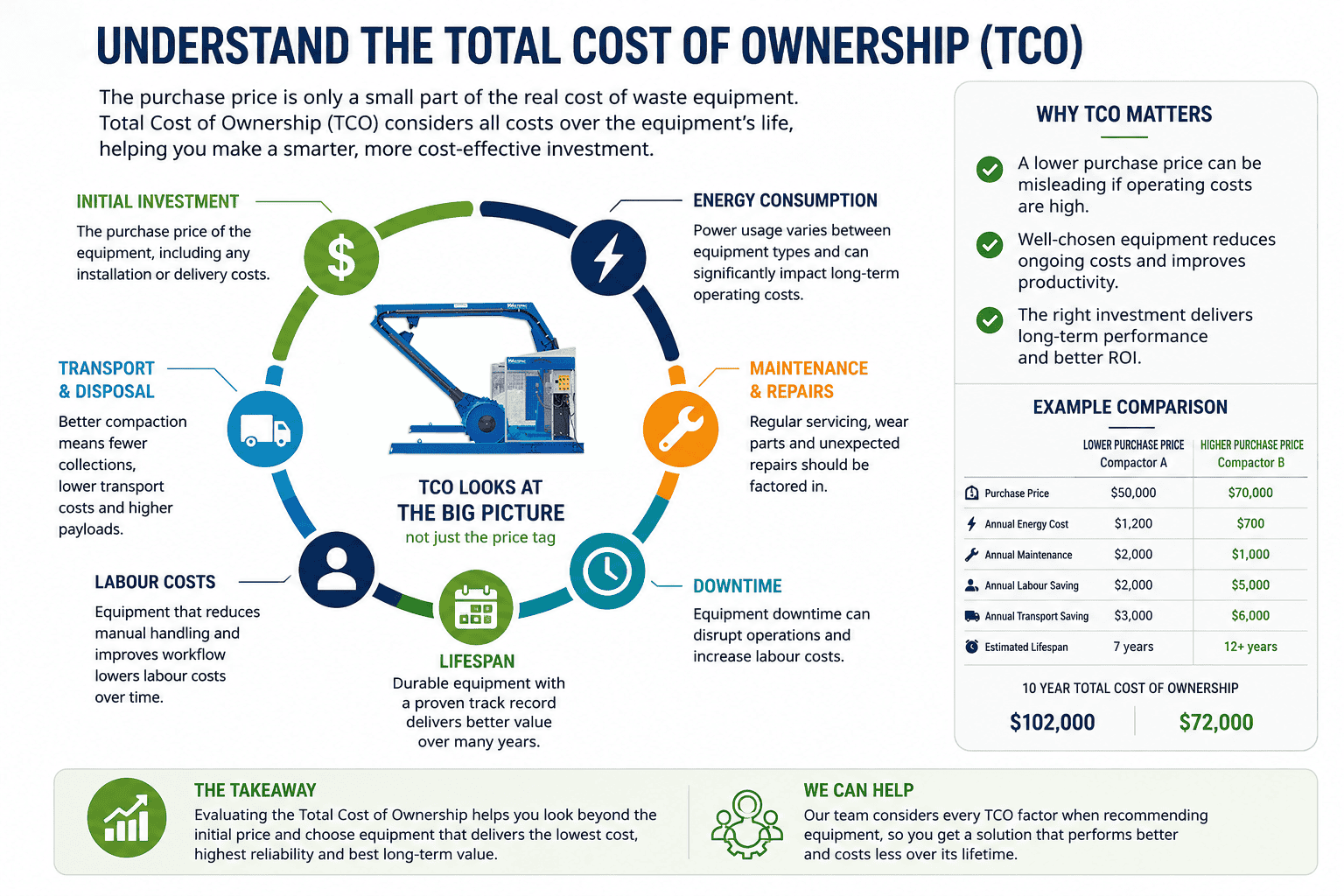
One of the most important considerations is looking beyond the initial purchase price. While lower capital costs may seem attractive, they don’t always result in the lowest operating costs. Labour requirements, transport savings, maintenance, equipment reliability and downtime all contribute to the total cost of ownership over the life of the equipment.
It’s also worth considering whether different waste streams are best managed by different pieces of equipment. While it may seem more economical to process everything through a single machine, materials such as cardboard, plastic film, timber and general waste each have different handling characteristics. Matching equipment to individual waste streams often delivers better operational efficiency and improved recycling outcomes.
Future requirements should also form part of the decision-making process. Considering expected business growth, changing production volumes, site layout and how waste moves throughout the facility helps ensure the selected equipment continues to support the operation well into the future.
Ultimately, the most successful equipment investments begin with a thorough understanding of the operational challenge. Once the waste stream, workflow and business objectives are clearly defined, selecting the right solution becomes a far more confident and informed decision.
Choosing the Right Equipment Partner
Selecting the right equipment is only part of a successful project. Equally important is selecting the right partner.
An experienced supplier should do more than recommend machinery. They should understand your operation, assess your waste streams, evaluate workflow, provide installation support, train operators and remain available long after commissioning.
Local engineering capability, readily available spare parts, preventative maintenance and responsive service all contribute to maximising equipment uptime and protecting your investment throughout its operating life.
These factors often have a greater influence on long-term success than small differences between competing machine specifications.
Why a Waste Assessment Delivers Better Outcomes
A professional waste assessment removes much of the uncertainty from equipment selection. Rather than focusing solely on machinery, it considers:
- your waste streams
- handling methods
- operational workflow
- available space
- future business objectives
The assessment may identify opportunities to improve recycling rates, reduce transport costs, simplify material handling or combine multiple waste streams into a more efficient overall system.
In many cases, the outcome is not simply selecting better equipment, but designing a better waste management process.
There is no universal solution when selecting waste equipment because every operation is different.
The most successful investments begin with understanding the waste being generated, how it moves through the site, the operational objectives you are trying to achieve and where the business is likely to be in the future.
Whether your solution involves a baler, compactor, roll packer or a complete waste handling system, the goal remains the same: improve operational efficiency while reducing the total cost of managing waste.
Choosing the right equipment isn’t about purchasing a machine. It’s about investing in a solution that supports your operation for years to come.
Book a Waste Assessment
If you’re planning to invest in new waste equipment or simply want to understand whether your current system can be improved, Waste Initiatives can help.
Our engineering team can assess your waste streams, operational workflow and site constraints before recommending a solution tailored to your business. The result is a practical, evidence-based recommendation focused on long-term operational performance rather than simply selecting a machine.
Frequently Asked Questions
How do I know which waste equipment is right for my operation?
The best starting point is understanding your waste stream, waste volumes, operational objectives and available space. Equipment should be selected to solve these operational challenges rather than simply process waste.
Should I choose a baler or a compactor?
If your material has recyclable value, such as cardboard or plastic film, a baler is generally the most appropriate solution. Mixed or general waste is typically better suited to a compactor. Many operations benefit from both.
When is a roll packer the better option?
Roll packers are ideal for bulky waste such as timber pallets, crates and packaging timber where waste is collected in open-top skips or hook-lift containers and increased payloads can significantly reduce transport costs.
How important is future growth when selecting equipment?
Very important. Waste equipment is often expected to operate for ten years or more, so future production increases, changing waste streams and evolving recycling targets should all be considered during equipment selection.
Can one machine handle multiple waste streams?
Sometimes, but separate equipment often delivers better results. Matching equipment to individual waste streams generally improves efficiency, recyclable quality and overall operating costs.
What should I look for in an equipment supplier?
Look beyond the machine itself. Engineering expertise, local service support, spare parts availability, operator training and long-term maintenance capability all contribute to the success of your investment.
Is a waste assessment or site visit worthwhile?
Yes. A professional waste assessment identifies opportunities to improve operational efficiency, reduce waste costs and recommend equipment based on your specific operation rather than generic assumptions.
How do I calculate the return on investment for waste equipment?
ROI should consider reduced labour, lower transport costs, fewer waste collections, improved recycling revenue, maintenance costs and the expected operating life of the equipment rather than purchase price alone.
Latest news
Cardboard Baler vs Compactor: Which Cuts Waste Costs for Warehouses and Retail?
From Machine Throughput to Processing Line Performance