Australia’s future solar panel waste stream is already installed across millions of rooftops and solar farms.
As at 31 December 2025, Australia had more than 4.29 million photovoltaic (PV) installations with a combined capacity exceeding 45.1 GW, according to the Australian PV Institute. The Australian Government estimates that around one million tonnes, or approximately 50 million solar panels, could enter the waste stream by 2035.
That figure is a projection, not a measurement of panels currently being discarded. Actual volumes will depend on panel life, early replacement and repowering, reuse opportunities and disposal practices.
Even so, the scale of Australia’s installed solar base raises an increasingly important question: what happens to solar panels at the end of their useful life?
The answer involves more than putting panels through a shredder. An effective system must determine whether a panel can be safely reused, manage collection and transport, separate its bonded structure and produce fractions that downstream processors can accept.
When does a solar panel reach end of life?
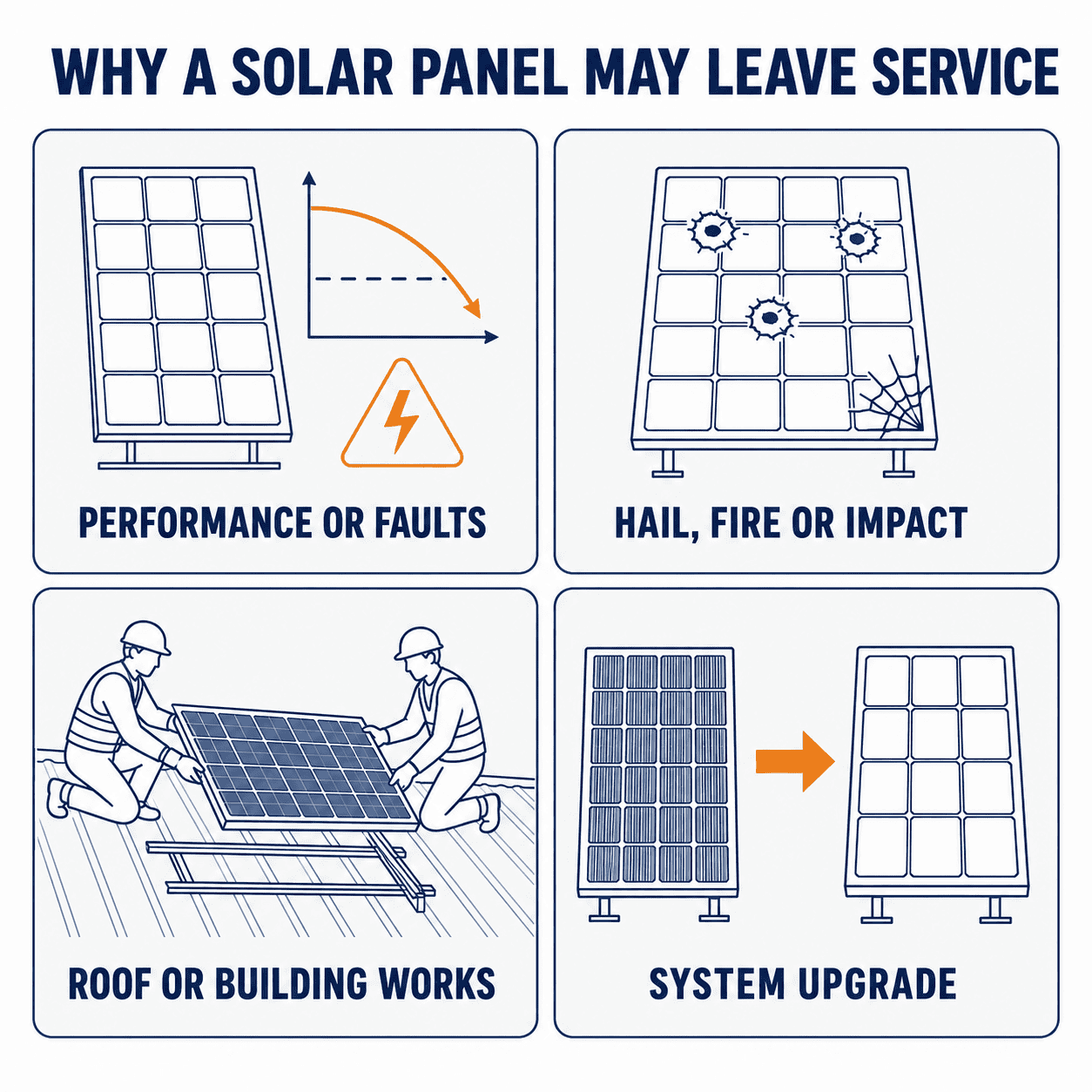
Solar panels leave service for several reasons. Some no longer provide acceptable performance, reliability or electrical safety. Others are removed after hail, fire or impact damage, electrical faults or recalls. Roof replacement, demolition and changes to an existing solar system can also lead to panels being removed before they stop generating electricity.
A removed solar panel is therefore not necessarily a failed panel. However, the fact that it can still generate electricity does not automatically make it suitable for reuse.
Guidance from the International Energy Agency Photovoltaic Power Systems Programme distinguishes between direct reuse, repair-assisted reuse and recycling. A credible reuse pathway requires assessment of a module’s physical condition, electrical safety, performance, reliability and suitability for its intended second-life application. Service history, traceability and documentation also matter.
Panels with cracked glass, exposed electrical components, serious delamination or fire damage should not be sent into second-hand markets simply because they still produce power. When safe continued use cannot be demonstrated, recycling is the appropriate pathway.
This triage preserves the functional value of suitable panels while keeping unsafe modules out of reuse markets.
What materials are found in a solar panel?
A typical crystalline-silicon solar panel contains:
- a large glass surface
- silicon photovoltaic cells
- an aluminium frame
- copper conductors
- small quantities of silver
- polymer encapsulant, commonly ethylene-vinyl acetate (EVA)
- a polymer backsheet or second sheet of glass
- a junction box, cables and connectors
- adhesives and sealants.
Glass and aluminium account for much of the mass of a conventional framed module, but the exact composition varies by manufacturer, age and panel design. Glass-glass modules differ from conventional glass-backsheet panels, while frameless modules do not provide an aluminium frame fraction.
Thin-film panels can contain different materials and may require another recycling process. A system designed for crystalline-silicon modules should not automatically be assumed to suit them.
Why are solar panels difficult to recycle?
Solar panels are not loose assemblies of easily detachable materials. Their layers are laminated and sealed to withstand years of heat, moisture, wind and mechanical stress.
Australian research examining 12 panels from different manufacturers found meaningful variation and reported that manual glass removal was difficult because of the laminate’s strength. The durability that protects a panel in service makes it difficult to separate.
Frames, cables and junction boxes are comparatively accessible. The main processing challenge is liberating glass, cells, conductors and polymers from the bonded laminate without producing fractions that are too contaminated for downstream use.
How are solar panels recycled?
The process depends on module technology, incoming condition and required outputs. For crystalline-silicon panels, it generally includes the following stages.
1. Safe decommissioning and handling
Panels must first be electrically isolated and removed in a way that avoids unnecessary breakage. Intact modules are easier to identify, test, stack and transport. Broken panels can introduce exposed conductors, sharp glass and loose fragments, making handling and sorting more difficult.
2. Identification and triage
Panels are classified by source, technology, model, condition and apparent damage. Available operating history can help determine whether a panel is suitable for reuse, requires further testing or repair, or should proceed to recycling.
Crystalline-silicon and thin-film modules should be kept separate where their treatment requirements differ.
3. Collection, storage and transport
After triage, panels must be aggregated and stored safely. This is a significant commercial issue in Australia, where household removals create relatively small consignments across a geographically dispersed collection network.
Stillages and defined storage areas may be required to separate reusable, quarantined and recyclable panels. Transport can represent a substantial cost, particularly when panels must travel long distances before sufficient processing volume is aggregated.
The Commonwealth’s National Solar Panel Recycling Pilot will test collection and transport arrangements. Its targets include approximately 100 collection sites and up to 250,000 panels. These are programme targets, not completed outcomes.
4. Removal of accessible components
Frames, cables and junction boxes may be removed manually or mechanically before the laminate is processed. Some automated systems are instead designed to accept whole framed panels and separate the aluminium during processing.
5. Size reduction and delamination
The remaining panel structure must be broken down so its bonded materials can be liberated. Recognised approaches include mechanical, thermal and chemical delamination.
Mechanical recycling can use crushing, shredding, milling or purpose-designed delamination equipment to separate glass, polymer, cell material and conductors. Controlled feeding and staged size reduction create a consistent flow for later separation.
Liberation is critical. Reducing a panel into smaller pieces is not enough if glass remains bonded to polymer or contaminated with cell material and metals.
6. Screening and material separation
Once materials have been liberated, screens classify particles by size. Magnetic separation can remove ferrous components, while non-ferrous, air, density or other separation technologies may be used to upgrade individual fractions.
Secondary delamination or refining can release material that remains bonded after the first processing stage. The sequence must be matched to the required particle size, purity and contamination limits of each downstream outlet.
7. Quality control and downstream refining
Recovered fractions should be sampled, assessed and stored separately. A glass buyer may specify contamination and particle size limits, while a refiner accepting cell-bearing concentrate will have different composition and minimum-volume requirements.
Some outputs can enter established recycling channels directly, while others require specialist treatment. A complete process includes physical separation and a verified destination for every stream.
What can be recovered from solar panels?
A mechanical solar panel recycling process can produce several output streams, although their quality and marketability must be confirmed.
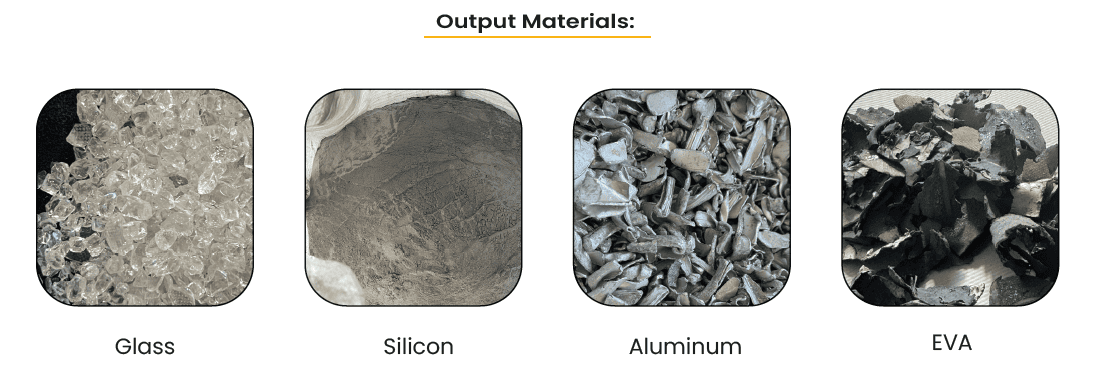
Aluminium
Aluminium frames are among the most accessible fractions. When the material meets buyer requirements for cleanliness and alloy composition, it can enter established metal recycling channels.
Copper and other metals
Copper can be recovered from cables and other metal-bearing components. Final separation or upgrading may occur within the plant or at a downstream metal recovery facility.
Glass
Glass represents a large proportion of panel mass, but mass does not necessarily equal value. Its destination depends on particle size and contamination by polymers, metals and semiconductor material.
Polymer-rich material
Mechanical processing can produce a fraction containing EVA encapsulant and backsheet material. Recycling outlets may be limited. Energy recovery may be possible depending on composition, regulation, facility approvals and the available offtakers, but it should not be reported as material recycling.
Silicon-rich concentrate
Mechanical processing may concentrate silicon cell material and small quantities of silver into a fine fraction. This output is not purified silicon, recovered silver or a finished commodity.
Recovering silver or higher-purity silicon generally requires further chemical, metallurgical or specialist refining. Claims should distinguish between producing a silicon-rich concentrate and recovering finished materials from it.
Not every output will be saleable. Operators should account for incoming material, recovered outputs, stored and rejected material, residues and final destinations. Recovery should be measured through to legitimate downstream use, not where material leaves a separator.
A complete solar panel recycling system
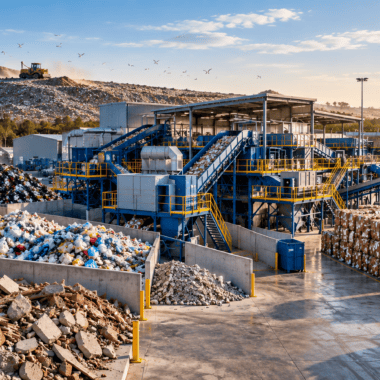
The Stokkermill solar panel recycling solutions available through Waste Initiatives use a completely mechanical process designed to accept whole panels without requiring frames and junction boxes to be removed first.
Depending on the selected configuration, the process can combine controlled feeding, size reduction, primary and secondary delamination, screening, magnetic separation and aluminium or other non-ferrous separation. Intended outputs include aluminium, coarse and fine glass, an EVA or polymer-rich fraction, silicon-rich concentrate and copper or other metals.
The recycling line is only one part of a complete facility. A project may also require:
- unloading equipment and panel stillages
- inspection, triage and quarantine areas
- conveyors and controlled dosing
- dust extraction and filtration
- noise and safety controls
- separate storage for each output
- sampling and quality-control equipment
- arrangements for rejected material and processing residues
- maintenance access and space for future expansion.
Representative trials are important before final equipment selection. Intact framed residential modules may behave differently from shattered panels, glass-glass modules or consistent batches removed from a solar farm. Testing should examine mass balance, material liberation, contamination and output quality, not simply whether panels pass through the line.
Waste Initiatives works with recyclers to assess feedstock, processing objectives, required outputs and site constraints before recommending a configuration. Current model-specific data and representative material trials should be used to confirm throughput, utilities and output specifications for each project.
Australia’s solar panel recycling infrastructure is developing
Australia does not yet have a mature national collection and recycling system for end-of-life solar panels, but activity is increasing.
The Australian Government has committed $24.7 million over three years to the National Solar Panel Recycling Pilot. Western Australia has separately invested $13 million through the Remade in WA programme to help establish collection and recycling pathways, with a baseline assessment examining reuse, infrastructure, regulation and market readiness.
In New South Wales, the EPA announced that a Bankstown facility was expected to process up to 6,000 tonnes, or approximately 200,000 panels, each year. These figures describe stated processing capacity, not verified annual throughput.
Projected waste volumes and equipment capacity do not establish that a facility will receive enough suitable material to operate economically.
A prospective operator needs to understand:
- how many tonnes are available each month
- whether supply is supported by contracts or collection agreements
- the condition and construction of incoming panels
- the distance panels must travel
- how solar farm campaigns or severe weather events may affect volumes
- the required specification and destination for each recovered output
- the minimum economic shipment size for downstream markets.
Different parts of the network may perform different roles. Councils might provide collection and aggregation without operating a complete recycling line. Regional recyclers could consolidate panels or undertake pre-processing, while centralised facilities provide advanced separation, quality control and downstream market coordination.
Plan for material destination
Australia’s projected rise in end-of-life solar panels supports investment in collection systems, processing trials and feasibility studies. It does not mean every region can immediately support an industrial recycling plant.
Before selecting solar panel recycling equipment, councils, recyclers and waste contractors need to establish the available feedstock, module types, reuse criteria, transport radius, site function and storage requirements. They also need credible specifications and destinations for glass, metals, polymer-rich material and silicon-bearing concentrate.
These factors determine whether a project should begin as a collection point, consolidation hub, pre-processing operation or complete separation facility.
The most effective end-of-life pathway is designed from both ends. It starts by identifying which panels can be safely reused and finishes by establishing who will accept each recovered fraction. The recycling system between those points must then deliver the liberation, separation and consistency those downstream markets require.
That is the difference between demonstrating that a solar panel is technically recyclable and building a system that recovers its materials in practice.
Waste Initiatives can help assess incoming solar panel volumes, required outputs, site constraints and the equipment needed to develop an integrated processing solution. Speak with our team to discuss your solar panel recycling requirements.
Sources:
- Australian PV Institute, PV Installation Analysis: https://pv-map.apvi.org.au/analyses
- Australian Department of Climate Change, Energy, the Environment and Water, National Solar Panel Recycling Pilot: https://www.dcceew.gov.au/environment/protection/waste/solar-panels
- Australian Centre for Advanced Photovoltaics and UNSW, Scoping Study: PV End-of-Life Management in Australia
- Bowen et al., Characterising the Composition of Photovoltaic Panels for Recycling in Australia
- IEA PVPS, Circular Economy Fact Sheet
- IEA PVPS, Second-Life PV Executive Summary
- IEA PVPS, Trends in Photovoltaic Module Recycling Technologies
- Western Australian Government, Advancing Solar Panel Recovery and Recycling in Western Australia: https://www.wa.gov.au/service/building-utilities-and-essential-services/waste-management/remade-wa-advancing-solar-panel-recovery-and-recycling-western-australia
- NSW EPA, Supercharging Solar Recycling with New Sydney Facility: https://www.epa.nsw.gov.au/news/epamedia/251028-supercharging-solar-recycling-with-new-sydney-facility
Frequently Asked Questions
Can solar panels be recycled?
Yes. Solar panels contain recoverable materials including glass, aluminium, copper and silicon-bearing material. However, effective recycling requires the bonded layers to be liberated and separated into fractions that meet downstream processor requirements.
What happens to solar panels at end of life?
Panels should first be assessed for safe reuse or repair. Those unsuitable for continued use can be collected, classified and processed through component removal, size reduction, delamination, screening and material separation.
What materials can be recovered from solar panels?
Mechanical processing can recover aluminium, glass, copper and other metals, along with polymer-rich material and silicon-rich concentrate. Some fractions can enter established recycling channels, while others require specialist downstream refining.
Can old solar panels be reused?
Some removed panels may be suitable for direct or repair-assisted reuse. Their electrical safety, condition, performance, reliability and service history should be assessed before they enter a second-life market.
Why are solar panels difficult to recycle?
Solar panels are designed to withstand decades of exposure to heat, moisture and mechanical stress. Their glass, cells, conductors and polymer layers are strongly bonded, making material liberation more complex than simply crushing or shredding the panel.
Do solar panels need to be dismantled before recycling?
This depends on the recycling system. Some processes require frames, cables and junction boxes to be removed first. Stokkermill mechanical recycling systems can be configured to accept whole framed panels and separate accessible materials during processing.
What equipment is needed to recycle solar panels?
A complete solar panel recycling system may include feeding equipment, size reduction, primary and secondary delamination, screening, magnetic and non-ferrous separation, conveyors, dust extraction and separate output storage. The configuration should be based on the incoming panels and required material outputs.
What should be assessed before investing in a recycling system?
Prospective operators should confirm available panel volumes, module types, collection arrangements, transport distances, storage requirements and downstream markets. Equipment should only be selected once there is a credible destination and specification for each recovered fraction.
Latest news
What Did Your Waste Operation Tell You This Year?
79 Million Tonnes of Waste: What Australia’s Latest Data Reveals