This article follows on from our previous guide, How to Select the Right Waste Equipment for Your Operation, where we explored how understanding your waste streams, material flow and operational objectives helps identify the right type of equipment. If you’ve already narrowed your options to a baler, compactor, shredder or complete waste processing system, the next question is just as important: how do you ensure you’re making the right long-term investment?
Investing in Equipment Is About More Than Buying a Machine
Purchasing waste equipment is one of the most significant capital investments many organisations will make. Whether the objective is reducing disposal costs, improving recycling rates, increasing operational efficiency or supporting business growth, the equipment you choose is likely to become part of your operation for the next 10 to 20 years.
That’s why successful purchasing decisions rarely come down to machine specifications or purchase price alone.
Two balers may produce similar bale weights. Two compactors may advertise the same compaction force. Two shredders may appear capable of processing the same throughput. Yet over their operating life, one may prove substantially more valuable because it requires less maintenance, reduces labour, receives better service support or adapts more easily as the business grows.
Experienced operators understand they aren’t simply purchasing equipment.
They’re investing in an operational asset that needs to deliver value every day.
Before committing to your next waste equipment investment, here are seven key considerations that can help maximise long-term performance and minimise the total cost of ownership.
1. Evaluate the Total Cost of Ownership, Not Just the Purchase Price
The purchase price is often the first figure compared when evaluating equipment quotations. While it naturally influences any purchasing decision, it rarely represents the true cost of owning the equipment.
A lower-priced machine may appear attractive initially, but if it requires additional labour, consumes more energy, experiences frequent downtime or demands higher maintenance costs, those ongoing expenses can quickly outweigh the initial saving.
This is why many organisations evaluate equipment using Total Cost of Ownership (TCO) rather than purchase price alone.
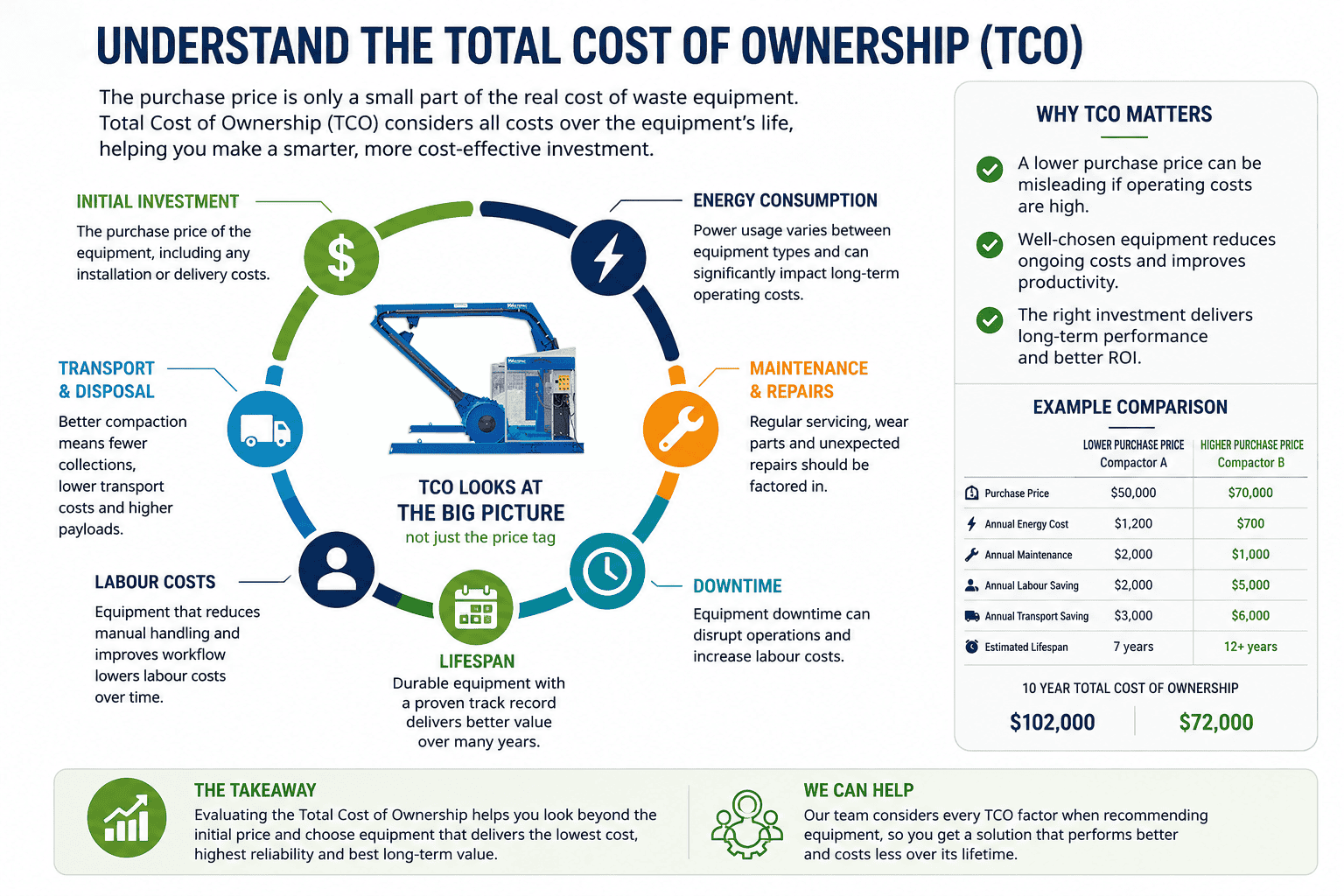
What Is the Total Cost of Ownership of Waste Equipment?
A realistic TCO assessment should consider:
- Initial purchase price
- Installation and commissioning
- Energy consumption
- Planned servicing and maintenance
- Wear parts such as blades and components
- Spare parts availability
- Equipment downtime
- Labour requirements
- Waste transport savings
- Expected service life
For example, a compactor that consistently achieves higher payloads may significantly reduce collection frequency, lowering transport costs for many years. Likewise, a baler producing denser, more consistent bales may improve handling efficiency while generating stronger returns from recyclable materials.
Looking at the complete operating picture often changes which investment represents the best value.
Questions to Ask Before You Buy
- What are the estimated annual operating costs?
- What maintenance is required throughout the equipment’s life?
- How frequently are wear parts replaced?
- How much labour will the equipment save?
- What transport savings could be achieved?
2. Make Sure the Equipment Fits Your Operation, Not Just Your Waste
In our previous article, we discussed the importance of understanding your waste stream before selecting equipment. Once you’ve identified the right type of machine, the next step is ensuring it integrates effectively into your operation.
Even the best equipment can become inefficient if it doesn’t suit the way your business works.
Consider the complete operational environment:
- Where is waste generated?
- How will material be loaded?
- Is forklift access available?
- Does ceiling height restrict equipment selection?
- Can collection vehicles access the installation safely?
- How much space is available for servicing and maintenance?
- These practical considerations often determine whether equipment improves productivity or unintentionally creates new bottlenecks.
For example, a larger baler may appear to offer greater capacity, but if loading requires operators to repeatedly move material across a warehouse, the additional labour may offset much of the productivity gain.
Similarly, locating a compactor away from the waste generation area may encourage temporary stockpiling, reducing valuable floor space and creating unnecessary handling.
The most effective waste equipment becomes part of the operational workflow rather than an add on process at the end of the operations.
Different industries require different solutions
A manufacturing facility may prioritise continuous operation with minimal operator intervention.
A distribution centre may focus on reducing cardboard handling and transport costs.
A council transfer station may require equipment capable of managing fluctuating seasonal volumes.
A recycling facility may need equipment that integrates seamlessly with conveyors, sorting systems and downstream processing equipment.
Every operation is different, and the equipment should reflect that.
Questions to Ask Before You Buy
- Can the solution be integrated into our current workflow?
- Is there sufficient space for installation and servicing?
- Will operators be able to use it efficiently?
- Will future site changes affect its suitability?
3. Look Beyond the Specification Sheet
Equipment specifications provide an excellent starting point for comparison, but they rarely tell the full story.
Processing capacity, hydraulic pressure, motor size and throughput figures are important, but they don’t necessarily indicate how reliably a machine will perform over thousands of operating hours.
Engineering quality often has a far greater influence on long-term performance.
When comparing equipment, look beyond the headline specifications and consider factors such as:
- Structural design and build quality
- Hydraulic system components
- Bearing selection
- Wear component design
- Corrosion protection
- Ease of maintenance
- Accessibility for servicing
- Expected duty cycle
For example, two shredders may advertise similar throughput capacities, yet one may be engineered specifically for continuous heavy-duty industrial operation while the other is designed for intermittent use.
Likewise, two vertical balers may produce similar bale weights, but differences in hydraulic design, component quality and serviceability can significantly affect reliability and maintenance costs over their lifetime.
Rather than asking, “Which machine has the highest specification?”, ask:
“Which machine has been engineered to perform reliably in our operating environment?”
Questions to Ask Before You Buy
- What duty cycle is the equipment designed for?
- How accessible are wear components?
- What maintenance can be completed on-site?
- What engineering features improve reliability?
4. Assess the Supplier as Carefully as the Equipment
Choosing the right equipment is only half of the investment decision.
The organisation supplying, commissioning and supporting that equipment will have a significant influence on its long-term performance.
A quality supplier should provide far more than a quotation.
They should understand your operation, evaluate your objectives and recommend solutions that genuinely suit your application rather than simply selling a particular product.
How Do You Compare Waste Equipment Suppliers?
Before committing to a supplier, consider:
Technical expertise:
- Can they explain why a particular solution is recommended?
- Do they understand your industry and waste stream?
Engineering capability
- Can they assist with system design, layout and future expansion?
Industry experience
- Have they completed similar installations?
- Can they provide relevant case studies or customer references?
Installation and commissioning
- Will they manage commissioning and operator training?
- Is ongoing optimisation available after installation?
The answers to these questions often reveal far more than a specification sheet ever could.
A supplier who understands your operation is more likely to recommend equipment that continues delivering value long after commissioning.
Questions to Ask Before You Buy
- Have you supplied similar equipment for businesses like ours?
- Can we speak with an existing customer?
- What support is included during installation?
- How will you help optimise the equipment after commissioning?
5. Consider the Service Behind the Equipment
No matter how well engineered a machine may be, every piece of equipment will eventually require servicing, replacement parts or technical support. The difference between a minor maintenance issue and a costly production stoppage often comes down to the quality of the supplier’s after-sales support.
When evaluating waste equipment, ask yourself not only “Who is supplying the machine?” but also “Who will support it over the next 10 to 20 years?”
Strong after-sales support protects your investment by reducing downtime, extending equipment life and ensuring the machine continues operating as efficiently as possible.
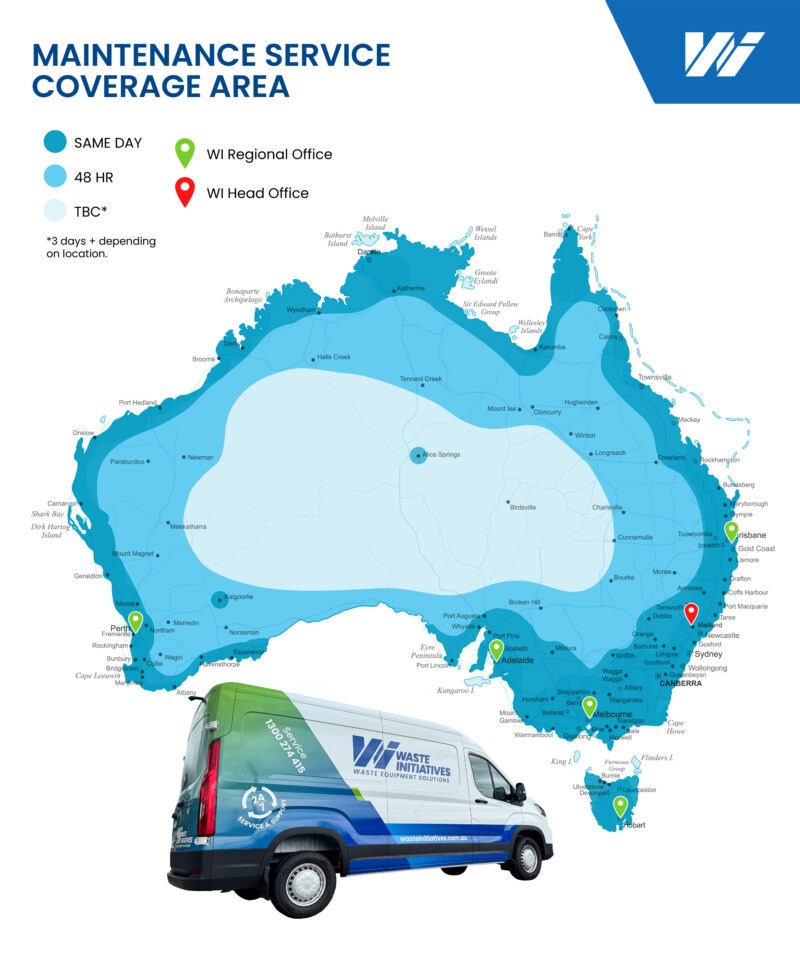
When comparing suppliers, consider:
Local service capability
- Does the supplier have qualified service technicians located within Australia?
- Can they respond quickly if the equipment experiences an unexpected breakdown?
Spare parts availability
- Are commonly used wear parts stocked locally, or will replacements need to be sourced internationally?
- Long lead times for relatively simple components can result in significant operational disruption.
Preventative maintenance
- Does the supplier offer planned maintenance programs designed to identify wear before failures occur?
- Routine servicing generally costs far less than emergency repairs and can significantly increase equipment lifespan.
Operator training
- Proper training improves more than safety. Well-trained operators typically achieve higher productivity, reduce avoidable wear and identify maintenance issues before they become costly repairs.
- Investing in quality equipment without considering long-term support is much like purchasing a commercial vehicle without knowing where it can be serviced.
Questions to Ask Before You Buy
- Where are your service technicians located?
- Are common spare parts stocked in Australia?
- What preventative maintenance programs are available?
- What training is included with installation?
- What are your typical response times for service callouts?
6. Build a Business Case Around Return on Investment
Every capital purchase competes for funding.
Whether you’re presenting a proposal to senior management, a procurement team or a finance department, demonstrating a clear return on investment (ROI) will help justify the purchase and provide measurable expectations after installation.
Fortunately, waste equipment often generates savings from multiple areas of the business.
These may include:
- Reduced waste collection frequency
- Lower landfill disposal costs
- Improved recycling revenue
- Reduced labour requirements
- Increased operational efficiency
- Improved workplace safety
- Reduced forklift movements and material handling
- Better utilisation of valuable floor space
Rather than focusing solely on the purchase price, build a simple financial model that compares your current operating costs against projected savings.
While every operation is different, presenting savings in this way provides decision-makers with a far clearer understanding of the investment than simply comparing equipment prices.
Remember that some benefits are difficult to quantify but still deliver significant value.
For example:
- Improved housekeeping
- Reduced workplace congestion
- Better presentation of the site
- Greater staff satisfaction
- Increased recycling performance
- Reduced manual handling risks
These operational improvements often become just as valuable as the direct financial savings over time.
Questions to Ask Before You Buy
- What measurable savings should we expect?
- Can the supplier help calculate our ROI?
- What assumptions have been used?
- Can these savings be validated through similar installations?
7. Invest for Tomorrow, Not Just Today
Waste equipment is rarely replaced after only a few years.
Many machines remain in operation for well over a decade, during which time businesses often experience significant change.
- Production increases
- Packaging evolves
- New recyclable materials emerge
- Landfill costs continue to rise
- Sustainability targets become more ambitious
The equipment selected today should be capable of supporting those changes without becoming an operational limitation.
Future-proofing doesn’t necessarily mean buying the largest machine available.
Instead, it means selecting equipment that provides flexibility.
This may include:
- Additional processing capacity
- Expansion into multiple shifts
- Integration with conveyors or automated feeding systems
- Additional waste streams
- Future processing equipment
- Site expansion
Just as importantly, consider whether your supplier will be capable of supporting your business as these requirements evolve.
A supplier with engineering capability can often assist with future system upgrades, additional equipment and process improvements without requiring an entirely new solution.
Thinking beyond today’s requirements helps maximise the value of your investment while reducing the likelihood of expensive equipment replacement in the future.
Questions to Ask Before You Buy
- Will this equipment still meet our needs in ten years?
- Can additional equipment be integrated later?
- How easily can the system be expanded?
- What support is available as our operation grows?
Bringing It All Together
Selecting the right waste equipment is about far more than comparing specifications or obtaining the lowest quotation.
As we discussed in our previous guide, understanding your waste stream and operational objectives helps identify the right type of equipment.
The next stage is evaluating the investment itself.
By looking beyond the machine and considering the broader operational picture, businesses can make more informed purchasing decisions that continue delivering value long after the equipment has been commissioned.
The seven considerations we’ve explored provide a practical framework for evaluating any waste equipment investment:
- Look beyond the purchase price and consider Total Cost of Ownership.
- Ensure the equipment fits your operational environment.
- Evaluate engineering quality, not just specifications.
- Assess the supplier’s capability as carefully as the equipment itself.
- Consider long-term service and support.
- Build a business case around measurable return on investment.
- Invest with future growth in mind.
No two businesses generate waste in exactly the same way, which means there is rarely a one-size-fits-all solution.
The best outcomes are achieved when equipment is selected as part of a broader operational strategy, supported by experienced engineering advice and backed by reliable long-term service.
Ultimately, you’re not simply investing in a machine. You’re investing in a solution that should continue reducing costs, improving efficiency and supporting your business for many years to come.
If you’re planning your next waste equipment purchase, speak with our team for practical advice on selecting a solution that delivers long-term operational value.
Frequently Asked Questions
What should I consider before investing in waste equipment?
Start by understanding the total cost of ownership rather than focusing solely on purchase price. You should also evaluate engineering quality, service support, operator safety, future expansion, supplier capability and expected return on investment.
Why is Total Cost of Ownership more important than purchase price?
Purchase price represents only a portion of the equipment’s lifetime cost. Maintenance, labour, transport, energy consumption and downtime often have a much greater financial impact over the life of the machine.
How do I compare two similar pieces of equipment?
Look beyond the specification sheet. Compare build quality, duty cycle, maintenance requirements, local service capability, spare parts availability and long-term operating costs.
How can I calculate the return on investment for waste equipment?
Compare your current waste disposal, transport and labour costs against the projected savings the equipment will deliver. Include ongoing operating costs to estimate an expected payback period.
Why is local service support important?
Fast access to qualified technicians and locally stocked spare parts helps minimise downtime, protects productivity and extends equipment life.
Should I buy equipment based only on today’s requirements?
No. Waste equipment is typically a long-term investment, so future growth, additional waste streams and potential automation should all be considered before making a purchasing decision.
Latest news
Cardboard Baler vs Compactor: Which Cuts Waste Costs for Warehouses and Retail?
From Machine Throughput to Processing Line Performance