Australia’s tyre recycling sector continues to evolve as recyclers, waste operators, councils and processors face increasing pressure to safely manage growing volumes of end-of-life tyres.
From passenger vehicle tyres through to truck and bus tyres (heavy commercial), waste tyres represent one of the more difficult waste streams to process efficiently. Tyres are bulky, heavily reinforced, difficult to transport and engineered to resist cutting, abrasion and wear. While these characteristics are essential during the operational life of a tyre, they create major challenges once the tyre reaches end of life.
The scale of the challenge is continuing to grow. According to Tyre Stewardship Australia (TSA), there are currently around 7 million heavy commercial tyres in use across Australia, with this figure projected to exceed 10 million tyres by 2045 as freight, infrastructure and transport sectors continue to expand. A recent report released by the TSA highlights that heavy commercial tyre retreading and reuse already reduces waste generation by approximately 16,000 tonnes annually in Australia.
As tyre volumes continue to increase, modern tyre recycling is increasingly reliant on staged processing systems designed to progressively reduce tyre material while separating valuable rubber, steel and fibre fractions for reuse.
This staged approach is particularly important when processing truck and bus tyres, where heavy steel bead bundles, thicker casings and higher reinforcement levels place extreme stress on downstream processing equipment.
One of the most important early stages in this workflow is tyre debeading.
Tyre debeading removes the heavy steel bead bundles from tyres before shredding, helping protect downstream tyre shredding equipment while improving throughput, reducing maintenance and supporting cleaner downstream material recovery.
This article explains how tyres are recycled in Australia, why truck tyre recycling requires additional processing stages, and where tyre debeading fits into modern tyre recycling systems.
Why Tyres Are Difficult To Recycle
Tyres are specifically engineered to survive some of the harshest operating conditions found in transport and industrial environments.
Modern tyres must withstand:
- High vehicle loads
- Constant flexing
- Abrasion
- Heat
- Impact forces
- Long-distance travel
- Harsh road conditions
To achieve this, tyres are manufactured using multiple bonded materials including:
- Natural rubber
- Synthetic rubber
- Heavy steel reinforcement
- High-tensile bead wire
- Textile fibres
- Carbon black
- Chemical additives
According to Tyre Stewardship Australia, heavy commercial tyres contain substantial recoverable material fractions including rubber, steel and carbon black, making them highly valuable waste streams when properly processed.
However, these same reinforced materials make tyres extremely difficult to recycle using standard waste processing equipment.
Why Standard Machinery Struggles With Tyres
Unlike general waste streams, tyres do not fracture easily under force.
Instead, tyres:
- Absorb impact energy
- Flex under compression
- Resist cutting
- Retain embedded steel during shredding
This creates operational challenges including:
- Excessive cutter wear
- Increased torque loading
- Reduced throughput
- High maintenance demands
- Difficult downstream separation
Tyres also create storage and handling challenges due to:
- Fire risks
- Bulky transport inefficiencies
- High stockpile volumes
- Difficult manual handling
These challenges become significantly greater when processing truck and bus tyres, which are not only bigger and heavier than their passenger, SUV and 4×4 counterparts, but they also contain significantly more material.
How Passenger Tyres Are Typically Processed
Passenger and SUV tyres are generally the simplest category of tyre to process within tyre recycling systems.
Compared with truck tyres, passenger tyres contain:
- Smaller steel bead bundles
- Lighter casing construction
- Lower overall steel content
- Smaller tyre dimensions
Because of this, many passenger tyre recycling systems can process whole tyres directly through primary shredders without requiring extensive pre-processing.
Typical Passenger Tyre Recycling Workflow
Passenger tyre recycling systems commonly include:
- Collection and inspection
- Primary shredding
- Discharge to TDF
OR
- Collection and inspection
- Primary shredding
- Secondary shredding
- Metal separation
- Granulation
- Fibre removal
- Crumb or powder production
Depending on the desired end product, outputs may include:
- Tyre Derived Fuel (TDF)
- Rubber crumb
- Fine rubber powder
- Recovered steel
Passenger tyre recycling systems are typically designed around throughput efficiency and material recovery while maintaining manageable equipment wear.
However, larger commercial tyres require additional preparation stages.
Why Truck And Bus Tyres Require Additional Processing
Truck and bus tyres are substantially more difficult to process than passenger tyres.
Heavy commercial tyres are designed for significantly longer service life, heavier loading and more demanding operating environments. These tyres are specifically engineered with thicker casings, higher steel content and heavily reinforced bead structures.
These design characteristics make truck tyres ideal for long-term transport applications, but they also create major challenges during recycling.
What Makes Truck Tyres Harder To Recycle?
Truck and bus tyres typically contain:
- Larger bead wire bundles
- Higher steel reinforcement
- Thicker sidewalls
- Greater rubber mass
- Heavier overall construction
- Increased cutting resistance
These tyres place substantially greater stress on shredders and downstream processing systems.
Why Direct Shredding Of Truck Tyres Causes Problems
Feeding truck tyres directly into some shredders can lead to:
- Accelerated cutter wear
- Increased shaft loading
- Higher power consumption
- Reduced throughput
- Frequent maintenance interruptions
- Excessive shock loading
This is where tyre debeading becomes important.
What Is Tyre Debeading?
Tyre debeading is the process of removing the heavy steel bead bundles from a tyre before it enters downstream shredding systems.
Debeading is particularly important in truck tyre recycling and bus tyre recycling systems where bead bundles are substantially larger and denser than those found in passenger tyres.
What Is The Tyre Bead?
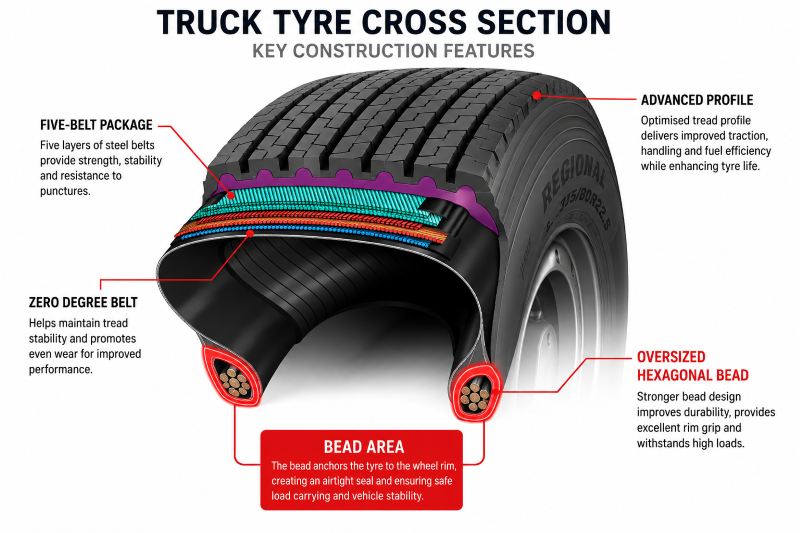
The tyre bead is the reinforced steel section located around the inner circumference of the tyre.
The bead performs several critical functions including:
- Securing the tyre to the wheel rim
- Maintaining structural stability
- Supporting tyre pressure
- Handling heavy operational loads
The bead area contains tightly wound high-tensile steel wire that is extremely dense and highly resistant to cutting.
In truck tyres, bead bundles are significantly larger than passenger tyre beads and can become one of the most damaging sections of the tyre for shredding equipment.
How Does A Truck Tyre Debeader Work?
A truck tyre debeader mechanically extracts the steel bead bundle from the tyre casing before shredding.
In a typical tyre debeading process:
- The tyre is positioned within the machine
- A hydraulic pulling mechanism grips the bead wire
- The steel bead bundle is extracted from the casing
- The tyre carcass proceeds to shredding
- The recovered steel is separated for recycling
This removes one of the most difficult components of the tyre before the material reaches downstream shredders.
Why Is Tyre Debeading Important?
Tyre debeading provides several operational benefits across the recycling workflow.
Reduced Shredder Wear
Removing heavy bead wire significantly reduces stress on shredder cutters, shafts and drive systems.
This helps extend equipment life while reducing maintenance costs.
Improved Throughput
Without large bead bundles entering the shredder, material can process more consistently and efficiently.
Cleaner Downstream Processing
Early steel removal improves downstream rubber separation and helps produce cleaner crumb and powder outputs.
Safer Equipment Operation
Reducing heavy steel contamination helps minimise equipment shock loading and improves processing stability.
Improved Overall System Efficiency
Debeading allows each downstream processing stage to focus on its intended material reduction task.
This staged processing approach improves overall system efficiency and downstream recovery performance.
Where Debeading Fits In The Tyre Recycling Process
Modern tyre recycling systems are designed as integrated staged processing lines rather than standalone machines.
Each stage progressively reduces tyre material while separating valuable recyclable fractions.
Typical Tyre Recycling Workflow
1. Collection And Inspection
Tyres are collected from:
- Tyre retailers
- Fleet operators
- Councils
- Transfer stations
- Industrial sites
- Landfill diversion programs
Tyres are inspected and sorted by type, size and condition.
2. Tyre Debeading
Truck and bus tyres are processed through tyre debeaders to remove heavy steel bead bundles before shredding.
This stage protects downstream equipment while improving material flow.
3. Primary Shredding
Primary tyre shredders reduce whole tyres into manageable tyre strips or rough shreds.
Depending on the shredder, outputs are generally coarse and intended for further reduction. Some shredders can produce the right sized TDF in a single pass through or it drops the shredded bits onto a classifier that allows the right size TDF to pass while circulating the larger sized bits back into the same shredder for a second run.
If TDF is the primary output a primary shredder will usually be sufficient, depending on shredder type, input volume and desired output, otherwise a secondary shredder needs to be added to the line to further process and reduce the output from the primary shredder.
4. Secondary Shredding
Secondary shredders further reduce tyre material into more uniform particle sizes.
This stage supports:
- TDF production
- Improved metal liberation
- Cleaner downstream processing
- Crumb preparation
5. Rasper And Metal Removal
Raspers further reduce tyre material while helping separate embedded steel from rubber.
Magnetic separators remove ferrous contamination from the material stream.
6. Granulation
Granulators produce smaller rubber fractions suitable for tyre crumb production.
Fibre separation systems remove textile contamination from the rubber stream.
7. Milling And Tyre Powder Production
Fine milling systems reduce crumb into tyre powder for specialised industrial applications.

* Click on the image to download the detailed brochure
What Products Are Made From Recycled Tyres?
Tyre recycling converts difficult waste streams into reusable industrial materials.
Depending on the processing stage, recycled tyre products may include:
Tyre Derived Fuel (TDF)
TDF is produced from shredded tyre material and commonly used in:
- Cement kilns
- Industrial boilers
- Energy-intensive manufacturing
Tyres contain high calorific value, making them useful as alternative fuel sources.
Tyre Crumb
Tyre crumb is produced after steel and fibre removal.
Applications include:
- Playground surfacing
- Sports fields
- Rubber matting
- Rubberised asphalt
- Moulded rubber products
Tyre Powder
Tyre powder is used in:
- Rubber compounds
- Asphalt modification
- Industrial fillers
- Advanced manufacturing applications
How Primary And Secondary Tyre Shredding Systems Work
Tyre shredding systems form the backbone of tyre recycling infrastructure.
However, different tyre categories and desired outputs require different shredding approaches.
What Does A Primary Tyre Shredder Do?
Primary tyre shredders are designed to process whole tyres into manageable pieces.
These systems typically use:
- Two-shaft shredding technology
- High torque operation
- Slow-speed cutting systems
- Heavy-duty cutters
Primary shredders focus on controlled reduction rather than final material specification.
Why Secondary Shredding Matters
Secondary shredders further refine tyre material into more consistent particle sizes.
This supports:
- Improved steel separation
- Cleaner rubber outputs
- TDF specification requirements
- Granulation preparation
Secondary shredding becomes increasingly important when producing high-quality crumb or powder products.
How Shredder Selection Changes By Application
The correct tyre shredding equipment depends on several operational factors.
Passenger Tyre Recycling
Systems may prioritise:
- Throughput
- Simpler processing
- TDF production
- Lower operational complexity
Truck And Bus Tyre Recycling
Systems typically require:
- Tyre debeading
- Higher torque shredders
- Reinforced cutting systems
- Advanced separation stages
Crumb And Powder Production
Higher-value outputs require:
- Multi-stage reduction
- Cleaner material streams
- Precision granulation
- Advanced separation systems
Producing Tyre Crumb And Tyre Powder
Producing clean tyre crumb requires multiple downstream refinement stages.
What Does A Tyre Rasper Do?
A rasper further reduces shredded tyre material while liberating embedded steel from rubber.
This improves magnetic separation efficiency.
How Are Steel And Fibre Removed?
Modern tyre recycling systems use:
- Magnetic separators
- Fibre separation systems
- Air classification systems
These systems help produce cleaner rubber outputs suitable for value-added applications.
Why Clean Rubber Fractions Matter
Cleaner rubber fractions support higher-value downstream markets including:
- Rubberised asphalt
- Sporting surfaces
- Engineered rubber products
- Export-grade crumb
- Industrial manufacturing
The cleaner the rubber fraction, the broader the downstream reuse opportunities.
Choosing The Right Tyre Recycling Equipment
Tyre recycling equipment selection should be based on operational objectives rather than simply processing capacity.
Different tyre categories and end products require different system configurations.
Factors To Consider When Selecting Tyre Recycling Systems
Tyre Type
Consider whether the operation processes:
- Passenger tyres
- Truck tyres
- Bus tyres
- Mixed tyre streams
Truck tyres generally require heavier-duty equipment and often benefit from dedicated tyre debeading stages.
Desired End Product
System design changes depending on whether the goal is:
- TDF production
- Tyre shred production
- Crumb production
- Fine tyre powder
Higher-value outputs require additional separation and granulation stages.
Throughput Requirements
Larger recycling operations may require:
- Continuous processing
- Integrated conveying
- Automated separation systems
- Modular system expansion
The Importance Of Integrated Tyre Recycling Systems
Modern tyre recycling relies on staged integrated processing systems rather than isolated machines.
Each stage of the system must be matched to:
- Material type
- Throughput requirements
- Desired output
- Downstream recovery goals
This staged approach helps improve:
- Material flow efficiency
- Equipment longevity
- Recovery performance
- Product consistency
- Operational reliability
Waste Initiatives supports this approach through scalable tyre recycling solutions including:
- WastePac Debeaders
- WastePac shredders
- downstream tyre recycling systems
- modular processing lines
- Australian-based service and support
Integrated systems allow operators to progressively reduce tyre material while protecting critical downstream equipment and improving overall recovery efficiency.
Tyre recycling is a specialised, staged and increasingly important part of Australia’s circular economy infrastructure.
From passenger tyres through to heavily reinforced truck and bus tyres, different tyre categories require different processing approaches, equipment configurations and downstream recovery strategies.
Truck tyres in particular introduce major operational challenges due to their thick casings, high steel content and heavily reinforced bead structures. This is why tyre debeading has become such an important stage within modern truck tyre recycling systems.
By removing steel bead bundles before shredding, tyre debeading helps protect downstream equipment, improve throughput, reduce maintenance and support cleaner material recovery.
When integrated into properly designed tyre recycling systems, staged processing infrastructure can transform difficult waste tyres into valuable reusable resources including TDF, tyre crumb, tyre powder and recovered steel.
As Australia’s heavy commercial tyre sector continues to grow, properly matched tyre downsizing equipment, shredding systems and material recovery technologies will remain critical for improving recycling efficiency, supporting downstream reuse markets and reducing waste to landfill.
To learn more about tyre recycling systems, tyre downsizing equipment and tyre debeading solutions for passenger, truck and bus tyres, speak with Waste Initiatives about integrated tyre recycling systems suited to Australian operating conditions.
Latest news
What Did Your Waste Operation Tell You This Year?
79 Million Tonnes of Waste: What Australia’s Latest Data Reveals